35,500 to 148,000 Impressions in 6 Months: Why Templated SEO Gets You Nowhere and Custom Content Gets You There All at Once
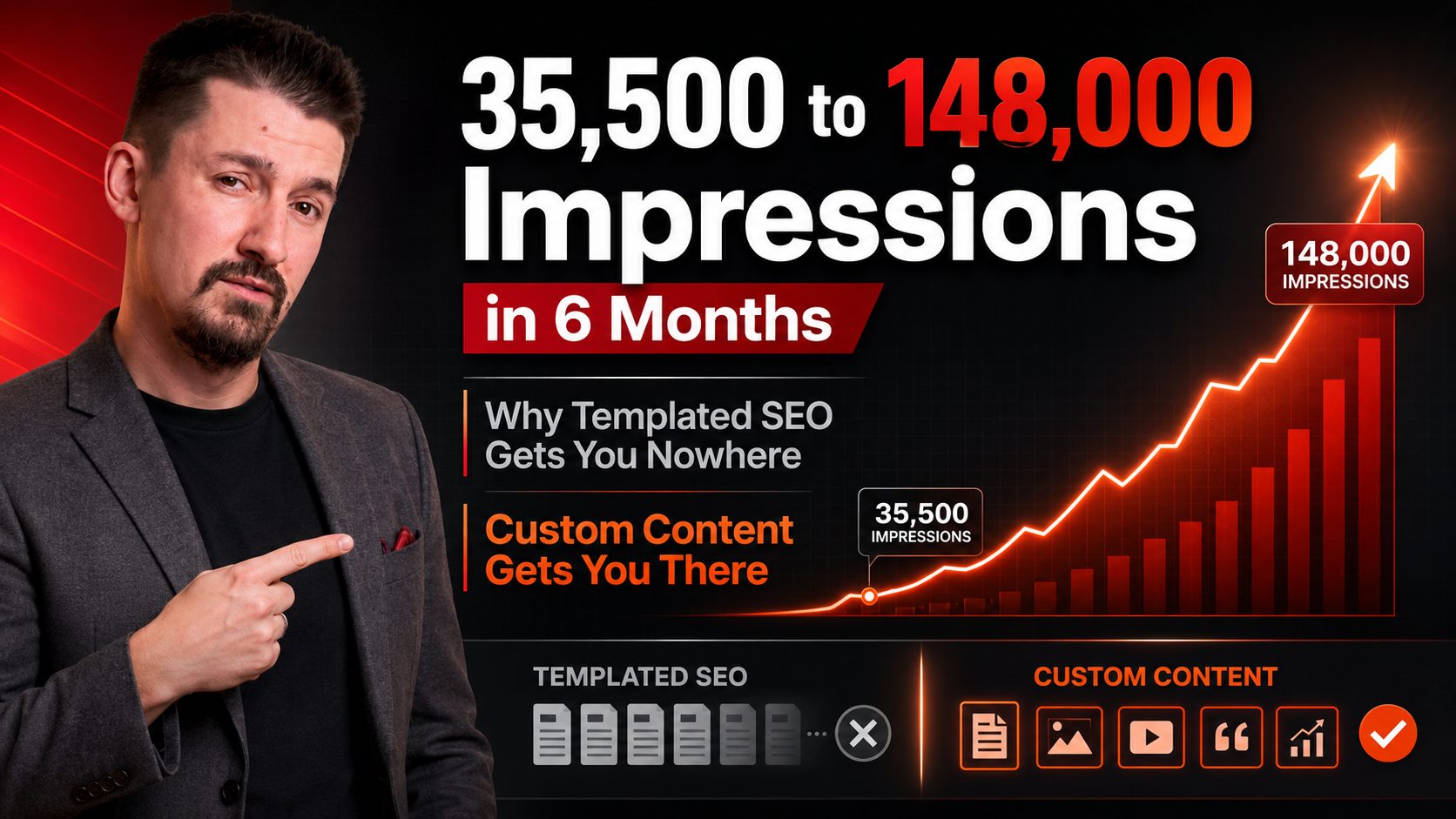
Most SEO agencies will sell you city pages like this:
"[Service] in [City]. We fix [appliances] in [City]. Call us in [City]."
Copy. Paste. Repeat 50 times. Invoice sent.
I've seen these pages. You've probably seen them too. They're everywhere in local service SEO because they're fast to produce, easy to sell, and nearly impossible to hold accountable — by the time the client realizes they're not working, six months have passed and the retainer has been paid.
I don't do that.
What should you do instead of templated content?
For a multi-location appliance repair client across 18 locations, I built three types of content — none of it templated:
Blog content built around PAA (People Also Ask) questions. Real questions Google shows to real users. Answered completely, in human language, with enough specificity to be genuinely useful. No keyword stuffing. No filler paragraphs.
Custom ZIP code pages with real local context. Not city name swaps. Actual neighborhood references, service radius specifics, local landmarks as orientation points. Content that reads like it was written by someone who's been to that area — because the research behind it was that thorough.
City hub pages written from scratch. Each one unique. Each one structured to funnel traffic down to the ZIP code and service-specific pages underneath it.
Is it slower than templating? Yes. Does it cost more time? Absolutely. There's no shortcut in this process that doesn't eventually show up as a gap in the results.
The Results After 6 Months
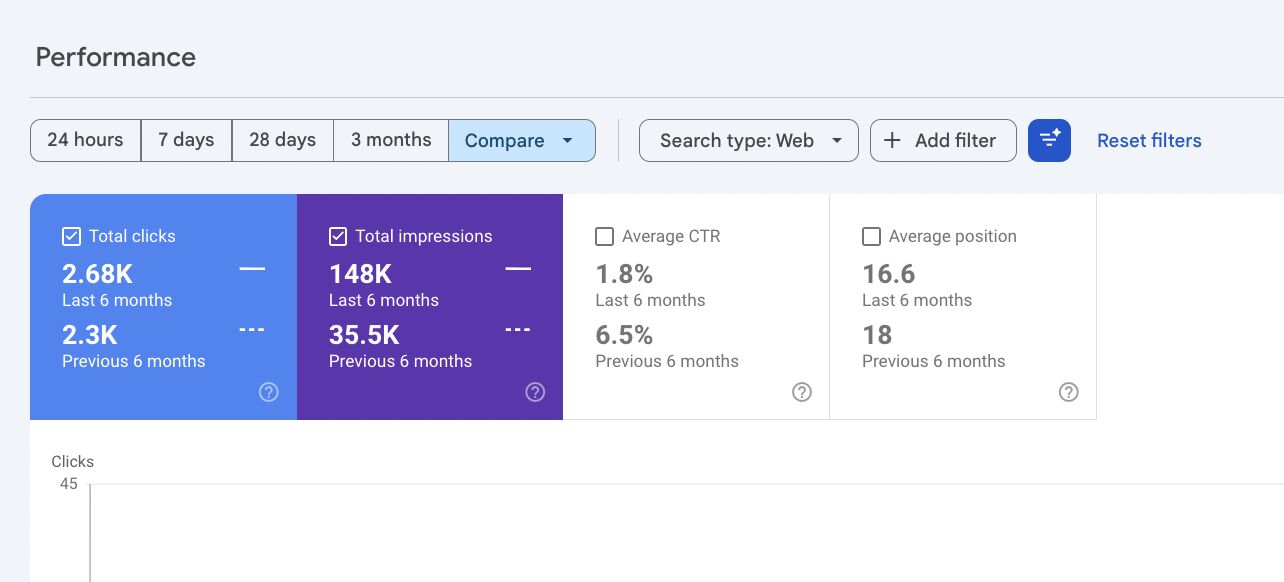
| Metric | Start | 6 Months Later | Change |
|---|---|---|---|
| Monthly impressions | 35,500 | 148,000 | +317% (4x) |
| Organic leads per day | 1 every 2–3 days | 4–5 per day | ~10x |
| Ad spend required | — | $0 | — |
| Average CTR | Higher | Lower (normal) | See below |
4x organic visibility in 6 months. No ad spend. Just people finding the business in organic search and calling.
On the CTR Drop (And Why It's Not Bad News)
The average CTR looks lower now than at the start. This confuses people. Let me explain why it's actually a sign the strategy is working.
When you start from low visibility, you're only showing up for the queries where you already rank well — typically branded terms or very specific long-tail searches. Your CTR on those is naturally high because the intent match is strong.
As the content graph expands, you start appearing for hundreds of new queries — many of them on page 2 or lower. Page 2 has low CTR by definition. So your average CTR drops even as your total clicks go up.
| Scenario | Impressions | Clicks | CTR |
|---|---|---|---|
| Small, focused visibility | 1,000 | 50 | 5% |
| Broad, growing visibility | 10,000 | 200 | 2% |
Lower CTR, 4x more clicks. That's the math. Clicks follow positions, positions follow content — and as positions improve on those new queries, the clicks compound.
The "SEO Is Dead" Problem
Right now, LinkedIn is full of posts saying SEO is dead. AI killed it. Search is changing. Stop investing in organic.
I want to be straight about what those posts actually are: bait.
"SEO is dead" is one of the most reliable engagement hooks in digital marketing. It triggers fear, generates comments from people defending SEO, gets shares from people who agree — and the person posting it gets visibility. That's the whole point. The post isn't an analysis. It's a fishing line.
SEO has been "dead" approximately once per year since 2010. Google Panda killed it. Then Penguin. Then RankBrain. Then voice search. Then mobile-first. Then AI Overviews. And yet here we are — organic search still drives more qualified traffic than paid for most local service businesses, at a fraction of the long-term cost.
What actually changes with each update is what bad SEO looks like. Templated city pages worked in 2018. They don't work now. Keyword-stuffed blog posts worked in 2015. They don't work now. The underlying principle — be genuinely useful to someone with a specific problem — has never changed and keeps getting rewarded.
There's No SEO Magic. There's Just Prompt Work and Attention.
People who commented on my original post about this kept asking about the "system." They expected something complex. A proprietary tool. A secret framework.
The honest answer: it's simpler than it looks.
The work is in the prompt. Every page starts with a clear brief — what question this page answers, what geography it covers, what the reader should know by the end. The AI generates a first draft based on that brief.
The work is in the review. AI will hallucinate. It will be generic when it should be specific. It will pad when it should be direct. Every page gets read. Every page gets corrected. The moment the output starts drifting toward filler, you fix the prompt and regenerate.
The work is in the iteration. What works gets repeated. What doesn't gets cut. I tracked every format change in Search Console — word count experiments, opening block variations, internal link structures. The current framework is the result of months of testing, not a genius insight on day one.
| What People Think the "System" Is | What It Actually Is |
|---|---|
| A secret tool or software | Google Search Console + RankMath |
| A proprietary AI prompt nobody else has | A clear brief + strict quality review |
| A technical SEO trick | Consistent content that answers real questions |
| Something you can copy in a weekend | Months of iteration and pattern recognition |
The reason it feels like a system is because it is one — but the system is discipline, not magic.
Templated SEO Gets You Nowhere Fast. Custom Content Gets You There Slowly — Then All at Once.
That's not a slogan. That's what the data shows.
The first few months of building real content look slow. You're publishing, you're tracking, you're seeing single-digit daily impressions. It feels like nothing is working.
Then it compounds. The internal links start distributing authority. The pages that ranked on page 2 move to page 1. The domain earns trust and new pages index faster. The impressions go from 35K to 148K. The leads go from one every few days to 4-5 every day.
It doesn't happen all at once — until suddenly it does.
Why does custom content also win in AI search?
The same gap that separates custom content from templates in Google rankings shows up even more sharply in AI search citations.
When Google AI Overview, ChatGPT Search, or Perplexity scans your site looking for an answer to cite, it needs a page that answers a specific question with structured, extractable information. A template page — "[Service] in [City]. We fix [appliances] in [City]." — has nothing to extract. A custom page that answers "how much does refrigerator repair cost in Charlotte" with a cost range, a numbered breakdown, and a FAQ section is exactly what gets cited.
| Content Type | AI Citation Potential | Reason |
|---|---|---|
| Template city page (name swap) | Very Low | No unique information to extract |
| Generic service page | Low | Too broad, no specific answer |
| Custom local page with specifics | Medium–High | Extractable answers, local data |
| PAA-based content with direct answers | High | Built to answer questions AI is asked |
| Structured FAQ with local data | High | Clean Q&A format AI systems prefer |
The businesses running templates aren't just missing Google rankings. They're invisible to AI search entirely — because there's nothing specific enough to cite. Custom content earns both.
Rebuilding pages so AI engines can actually quote them is a specific job with specific criteria, not a side effect of writing more words. I broke the process down step by step on AI citation visibility.
If your business is still paying for templated city pages that aren't moving the needle, I can audit what you have and tell you exactly what's missing. No generic recommendations — specific gaps, specific fixes. Let's talk.
Related:
- From 64 to 1,174 Pages: How I Built a Local SEO System That Drives 4-5 Organic Leads Per Day
- The SEO Strategy That Actually Worked: 14,050% Impressions Without Backlinks
- Google's March 2026 Update and AI Content: What the Doomers Got Wrong
- Testing My SEO Framework in a Completely Different Niche
- Google AI Overviews: What Home Service Businesses Need to Know in 2026