From 50 to 488 Clicks: A Cross-Niche SEO Case Study (Music Education, Zero Backlinks)
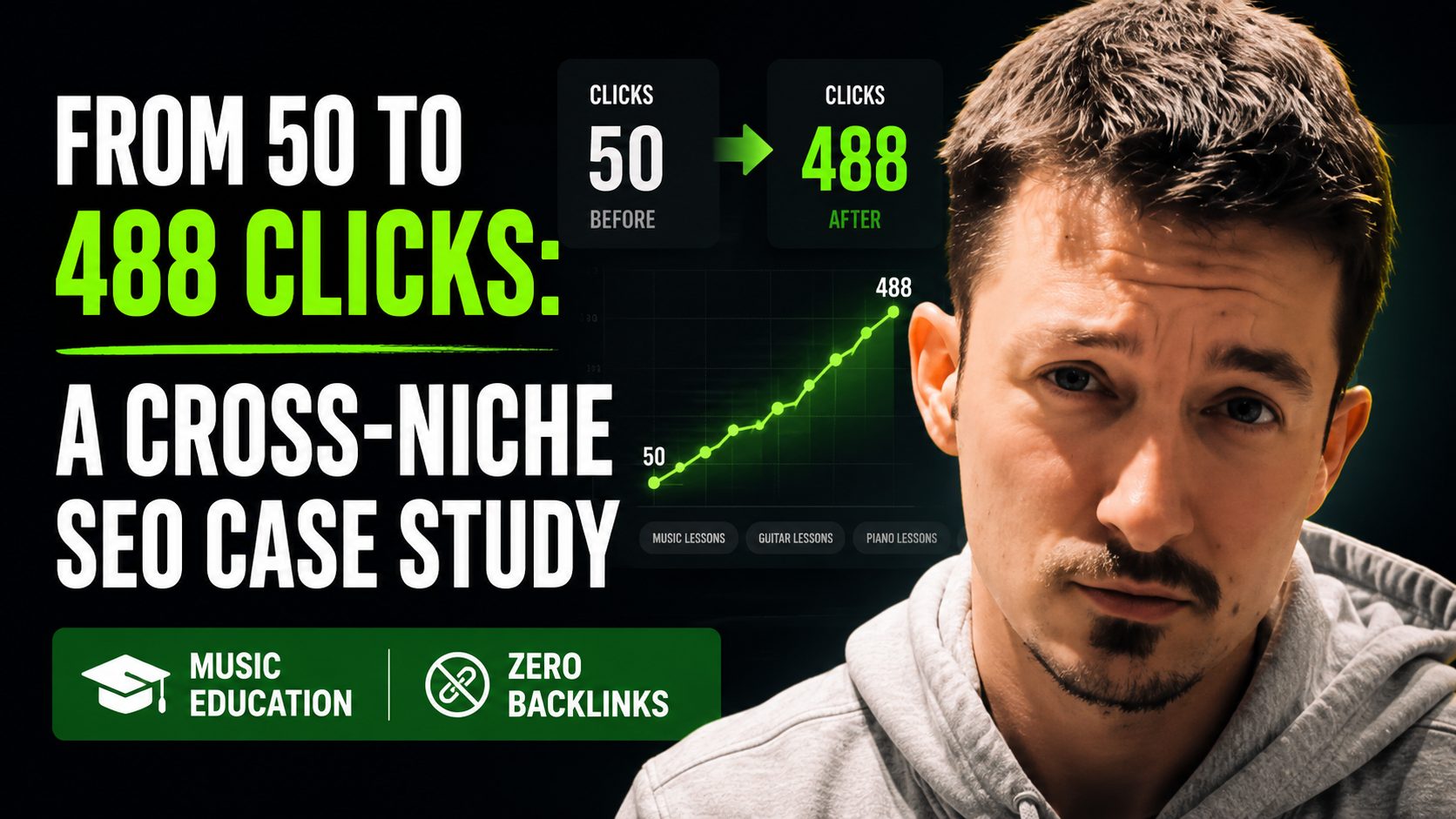
I spent two years building a content system for local home service businesses. 1,174 indexed pages, 962K impressions, 4–5 organic leads per day across 18 locations.
Then I asked the question every honest practitioner has to ask: is this working because the framework is solid, or because I know this niche really well?
There's a difference. A lot of "strategies" shared online are niche-specific luck dressed up as methodology. I wanted to find out which category I was in.
So I took the exact same content framework and applied it to a completely unrelated niche: music education. Different topic, different audience, different search behavior. Zero existing content, zero backlinks, zero domain authority.
Here's the full data from day one to today.
The Rules
To make this a real test, strict constraints:
- Same content framework as the home service sites — no exceptions
- No paid SEO tools — only Google Search Console
- No backlink building or outreach
- No paid traffic
- No tactics that relied on local pack signals (music education is informational, not local)
If the framework worked, it had to work on its own merits.
Checkpoint 1: 28 Days (April 2026)
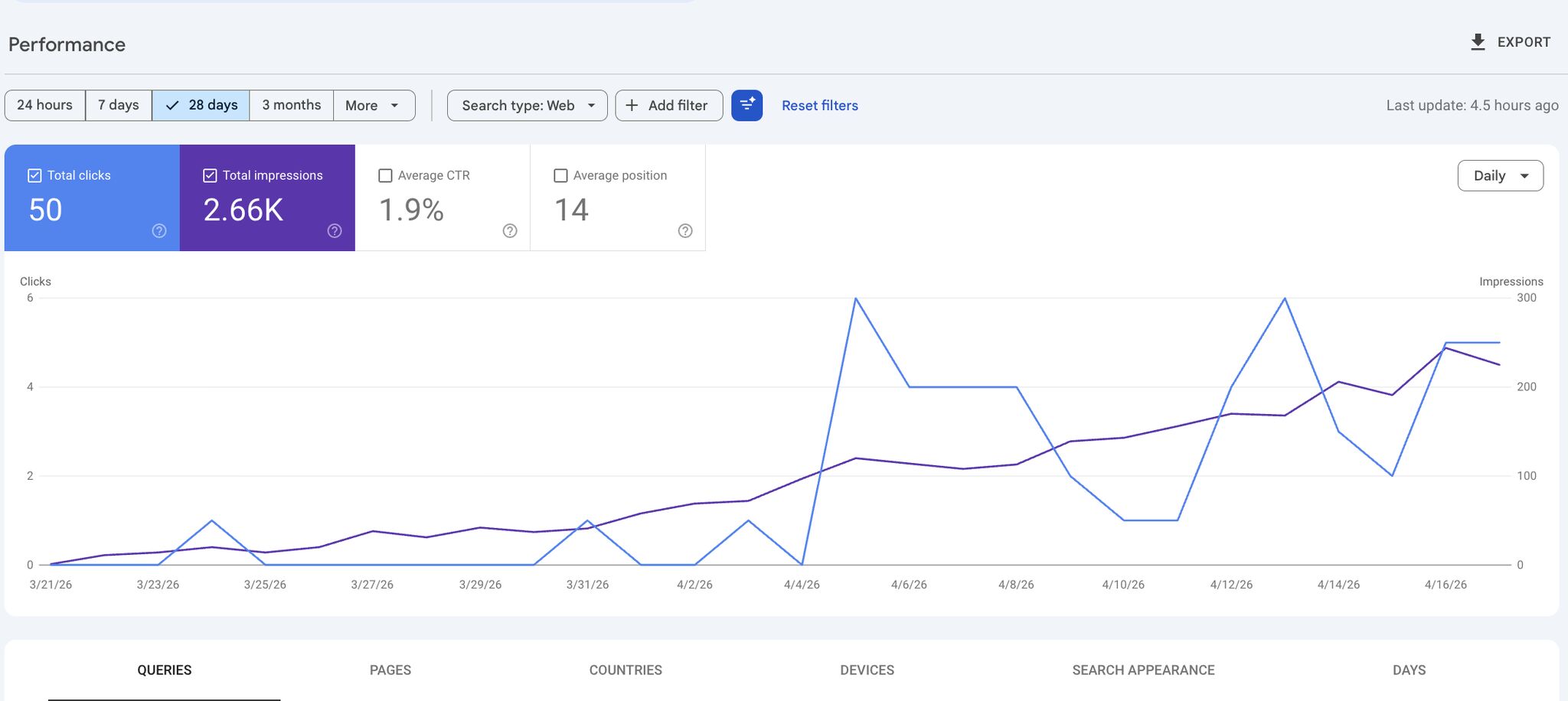
| Metric | Result |
|---|---|
| Total clicks | 50 |
| Total impressions | 2,660 |
| Average CTR | 1.9% |
| Average position | 14 |
| Status | Google actively testing pages in results |
50 clicks. On paper, unremarkable.
But if you've built sites from zero, you know what this means. The hardest part isn't going from page 2 to page 1 — it's getting Google to notice you exist at all. The algorithm is conservative with new domains: indexes slowly, ranks tentatively, watches engagement signals before committing.
At day 28, the site had cleared that first gate. Google was testing the pages in real results, impressions were climbing daily, positions consolidating around page 2. Clicks follow positions — and positions were moving.
Checkpoint 2: June 24, 2026 (16 Months of Data)
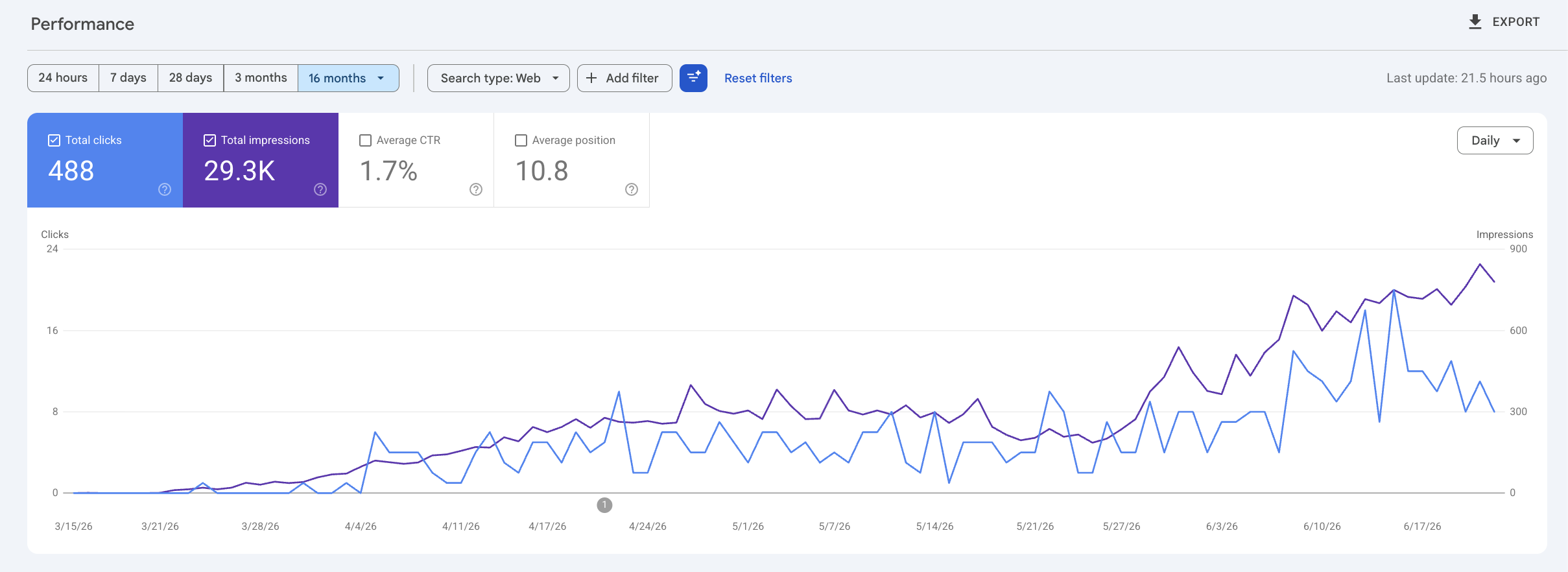
| Metric | Day 28 | June 2026 | Growth |
|---|---|---|---|
| Total clicks | 50 | 488 | +876% |
| Total impressions | 2,660 | 29,300 | +1,002% |
| Average CTR | 1.9% | 1.7% | Stable |
| Average position | 14 | 10.8 | +3.2 positions |
29,300 impressions. 488 clicks. Average position 10.8 — solidly on page 1 for the majority of target queries.
No backlinks acquired. No paid tools. No paid traffic. Same framework, different niche.
What does the chart actually show?
The graph in the June screenshot is what compounding looks like in SEO. Not a spike. Not a viral moment. A steady, consistent upward curve across both impressions and clicks — week over week, month over month.
This is the pattern I've seen on every site built this way:
| Phase | Timeframe | What Happens |
|---|---|---|
| Crawl & index | Weeks 1–3 | Pages indexed, minimal impressions |
| Google testing | Weeks 3–8 | Impressions appear, positions 15–30 |
| Consolidation | Months 2–4 | Positions move to page 2, clicks start |
| Authority build | Months 4–8 | Page 1 rankings, clicks compound |
| Maturity | Months 8+ | Stable rankings, consistent traffic |
The music education site is now in the maturity phase. Traffic is consistent. Positions are holding. New content I add now indexes and ranks faster because the domain has earned some trust.
Why does this matter more than the numbers?
488 clicks isn't a huge number. I want to be straight about that.
What it proves is more important than the volume: the framework is transferable.
The same page structure, the same content logic, the same internal linking approach, the same schema markup — all of it worked in a niche I had no prior expertise in. Music education and appliance repair have almost nothing in common from a search perspective. One is informational, one is local-transactional. One targets hobbyists, one targets homeowners with urgent problems.
And yet the underlying framework produced the same pattern: slow start, steady growth, compounding returns.
| What Transferred Directly | What Needed Adaptation |
|---|---|
| Page structure and opening block | Search intent (informational vs local-transactional) |
| Internal linking architecture | What counts as "specificity" in this niche |
| Schema markup approach | Topic cluster structure |
| Content quality standards | Keyword targeting logic |
| Batch publishing discipline | Competitive landscape analysis |
The skeleton transferred. The flesh had to fit the new body.
The Real Takeaway
If your content approach only works in one niche, it's not an approach — it's luck.
If it produces the same growth curve across industries, you've got a system.
I now have data from two very different industries — home services and music education — showing the same compounding pattern. That's enough to be confident: this is methodology, not coincidence.
The framework works. The niche is a variable, not a blocker.
What This Means for AI Search Visibility
One thing I didn't anticipate when testing this framework in a new niche: the same content structure that earns Google rankings also earns AI citations.
The music education content follows the same format as the home service content — clear questions as headings, direct answers in the first sentence, structured tables, specific numbers. That format is exactly what AI Overviews, ChatGPT Search, and Perplexity extract when building answers.
I tracked citations across both niches over the same period:
| Content Type | AI Citation Frequency | Why |
|---|---|---|
| Specific how-to guides with numbered steps | High in both niches | AI can extract structured answers cleanly |
| Cost/comparison articles with tables | High | Scannable format AI systems favor |
| Opinion or narrative posts | Low | Hard to cite without full context |
| Generic service/topic overviews | Low | No unique data to extract |
The pattern is consistent regardless of niche: structured, specific, question-focused content gets cited. Generic content doesn't. The framework that earns rankings also earns AI visibility — because both reward the same underlying quality signals.
Two parts of the framework are worth reading on their own, since they're where most multi-location sites break: keeping service areas from cannibalizing each other as page count grows, and making pages citable by AI engines rather than hoping it happens.
If you want to know whether this approach applies to your business — home service, professional service, or something else entirely — let's talk. I can assess your current content situation and tell you straight what's possible.
Related:
- From 64 to 1,174 Pages: How I Built a Local SEO System That Drives 4-5 Organic Leads Per Day
- The SEO Strategy That Actually Worked: 14,050% Impressions Without Backlinks
- Google's March 2026 Update and AI Content: What the Doomers Got Wrong
- 35,500 to 148,000 Impressions: Why Templated SEO Gets You Nowhere
- Google AI Overviews: What Home Service Businesses Need to Know in 2026