Google's March 2026 Update and AI Content: What the Doomers Got Wrong
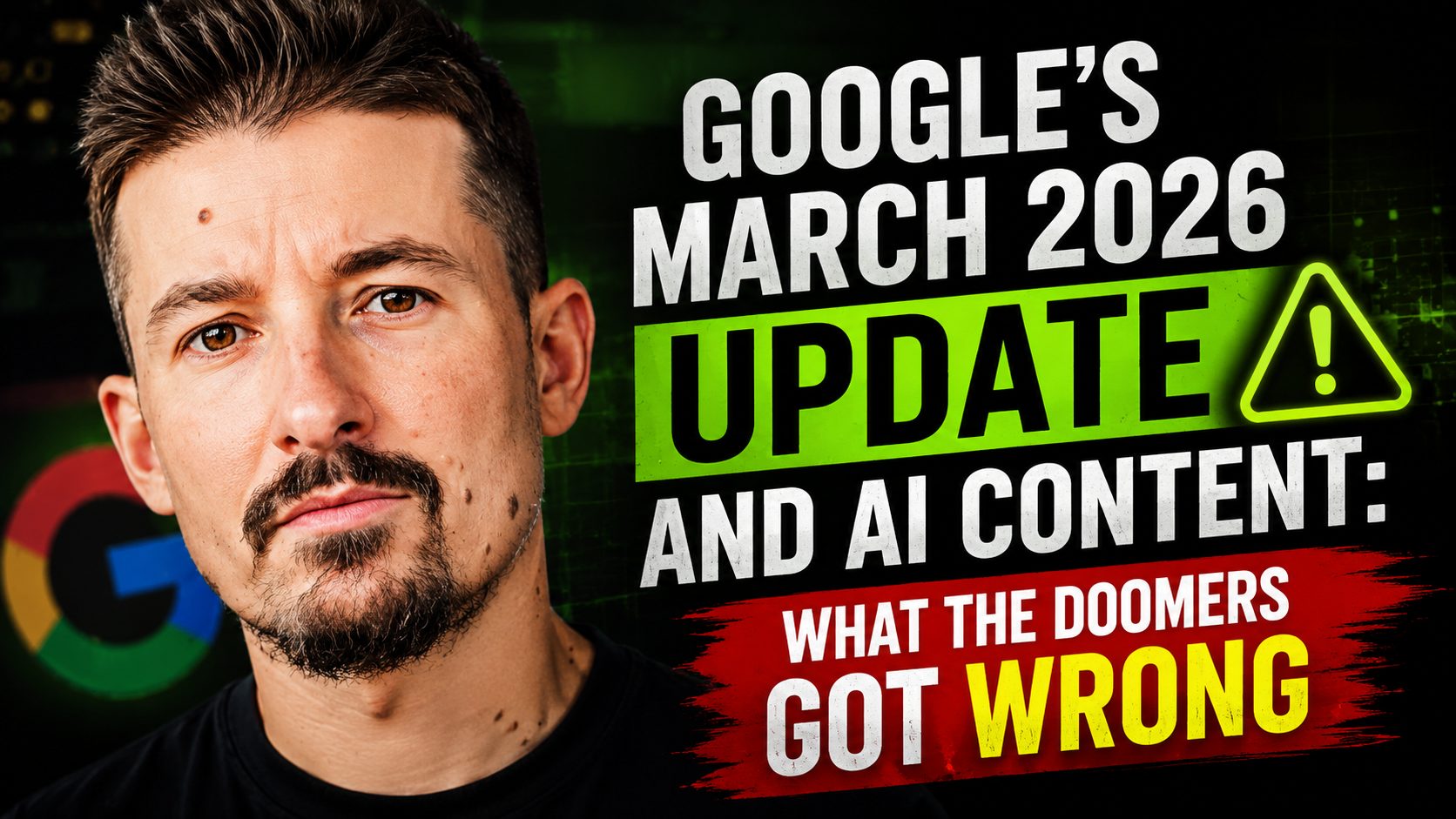
Saw a YouTube thumbnail this morning. Fire emojis, shocked faces, bold red text: "STOP USING AI?"
I didn't have an hour for a video. So I ran it through NotebookLM, pulled the key points, and compared them to what I've actually been doing for the past 8+ months.
The verdict: I've already solved every problem they're warning about.
The Pattern I Keep Seeing
There's a specific type of SEO content that thrives on fear.
A Google update drops. Nobody has data yet. Within 48 hours, LinkedIn and YouTube fill up with "EVERYTHING CHANGES NOW" posts. Dramatic thumbnails. Urgent language. The implicit message: whatever you're doing, stop. Buy this course instead. Subscribe for safety.
The problem isn't that these people are always wrong. Sometimes the warnings are legitimate. The problem is that fear-based content is optimized for engagement, not accuracy. A calm post saying "here's what actually changed and here's what the data shows" gets 200 views. A post saying "AI content is DEAD" gets 200,000.
The result is a constant stream of false alarms that paralyze people who are actually trying to build something. They stop testing. They stop publishing. They wait for certainty that never comes — while businesses that kept moving quietly take their market share.
I've watched this happen multiple times in the past year. Every update, the same cycle. And every time, the businesses I work with that kept publishing well-structured, genuinely useful content came out stronger on the other side.
What does Google's March 2026 update actually target?
When I stripped out the panic from the video and looked at what Google's documentation actually says, the targets are clear:
| What Gets Penalized | What Doesn't |
|---|---|
| Mass-produced pages with no editorial oversight | AI-assisted pages with human review at each step |
| Templates where only the city name changes | Pages with genuine local specificity |
| Zero information gain — rephrasing what already ranks | Content that adds something the reader can't find elsewhere |
| Thin pages pushed out at maximum volume | Smaller batches maintained for quality |
| No original data, photos, or experience signals | Real job photos, real results, real numbers |
None of this is new. Google has been saying this since the helpful content update in 2022. The March 2026 update didn't change the criteria — it got better at enforcing them.
What I've Been Doing for 8+ Months
280+ AI-assisted pages across 6+ US markets for a service-area business. Here's the actual process:
Every page goes through dozens of iterations. I tested word counts, structures, opening formats, how local specificity affects rankings. I tracked every change in Google Search Console. The current format didn't exist on day one — it was built through testing and iteration.
Batches of 5, never 10+. I learned this the hard way early on. When I pushed volume, quality dropped before I could feel it in the writing. The data showed it first — impressions would plateau, then dip. Smaller batches meant I could actually read and evaluate every page before publishing.
Real photos. Real neighborhoods. Not stock images, not "[City] + [Service]" fill-in-the-blank content. Actual job photos from actual locations. This is an experience signal Google explicitly rewards and no AI can fake.
I built 200+ pages the wrong way first. Early in the project, I pushed volume without enough quality control. Then I spent months rewriting every single one. That technical debt was painful. It was also the best education I've had in understanding what Google actually rewards versus what looks good in a content calendar.
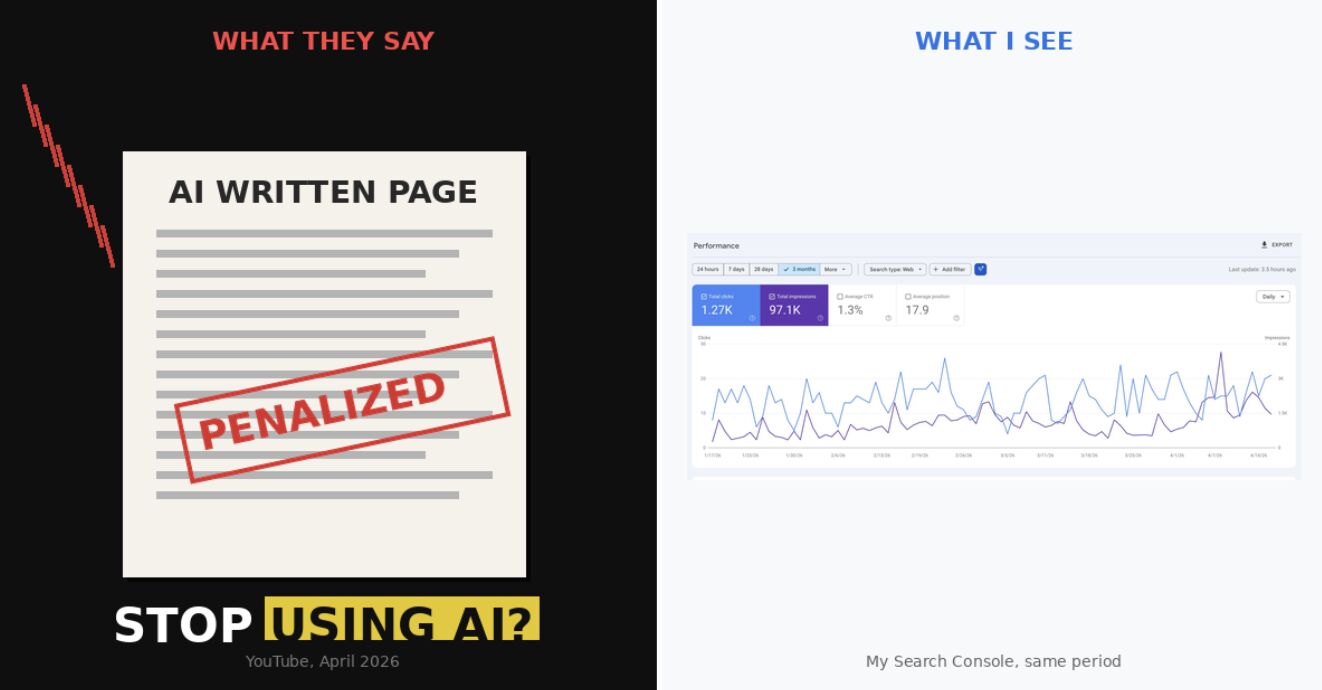
Post-update, the pages are ranking stronger than before. Not despite being AI-assisted. Because the process around the AI is sound.
What does the research actually show?
The data that exists on AI content and Google penalties tells a consistent story:
| Finding | Source |
|---|---|
| Near-zero correlation between AI usage and ranking penalties | Multiple SEO studies, 2025–2026 |
| 86% of top-ranking pages use AI assistance in content creation | Content analysis research |
| Pages penalized for "AI content" were penalized for thin/duplicate content, not AI use | Google documentation |
| Human editorial oversight is the differentiating factor, not the tool used | Google Quality Rater Guidelines |
Google doesn't have an "AI detector" that penalizes pages. It has quality signals — engagement, information gain, experience markers, originality — that have always applied to all content. AI just makes it faster to produce both good content and bad content. The tool isn't the variable. The process is.
The Real Skill Nobody Talks About
The YouTube video had a point buried underneath the panic: prompting matters.
But even that's not quite right. The real skill isn't prompting. It's knowing when the output isn't good enough.
Anyone can generate a page in 30 seconds. The judgment to look at that page and say "this doesn't sound like it was written by someone who actually does appliance repair in Charlotte" — and then fix it — that's what separates content that ranks from content that doesn't.
That judgment comes from knowing your subject, knowing your market, and caring enough about quality to not publish the first draft.
It can't be automated. It can't be thumbnailed. It doesn't fit in a 47-second hook. But it's the actual work.
Why I Don't Follow the Crowd
I don't watch SEO YouTube to decide what to do next. I run a test, measure the result in Search Console, and adjust based on what I see in my own data.
This sounds obvious. It's shockingly rare.
Most people — especially people new to SEO — consume content about SEO instead of doing SEO. They wait for consensus before trying something. And by the time consensus forms, the early movers have already captured the ground.
The businesses I work with that are growing fastest in organic search right now are not the ones who stopped publishing after the March update. They're the ones who looked at their own data, saw that quality content was still ranking, and kept building.
The same quality signals that survive updates are what AI engines look for when they pick a source to quote, which is why the two goals stopped being separate work — see AI citation visibility for the process side of it.
Your data is the only data that matters for your site in your market. Everything else is someone else's opinion about their own situation, packaged for engagement.
If you're not sure whether your current content approach would survive a quality update — or whether you're leaving organic traffic on the table because you're waiting for someone to tell you it's safe — let's talk. I can audit what you have and give you a straight answer.
Related:
- From 64 to 1,174 Pages: How I Built a Local SEO System That Drives 4-5 Organic Leads Per Day
- The SEO Strategy That Actually Worked: 14,050% Impressions Without Backlinks
- Google AI Overviews: What Home Service Businesses Need to Know in 2026
- 35,500 to 148,000 Impressions: Why Templated SEO Gets You Nowhere
- Before You Copy Someone's SEO Results, Understand Their Business Model