Before You Copy Someone's SEO Results, Understand Their Business Model
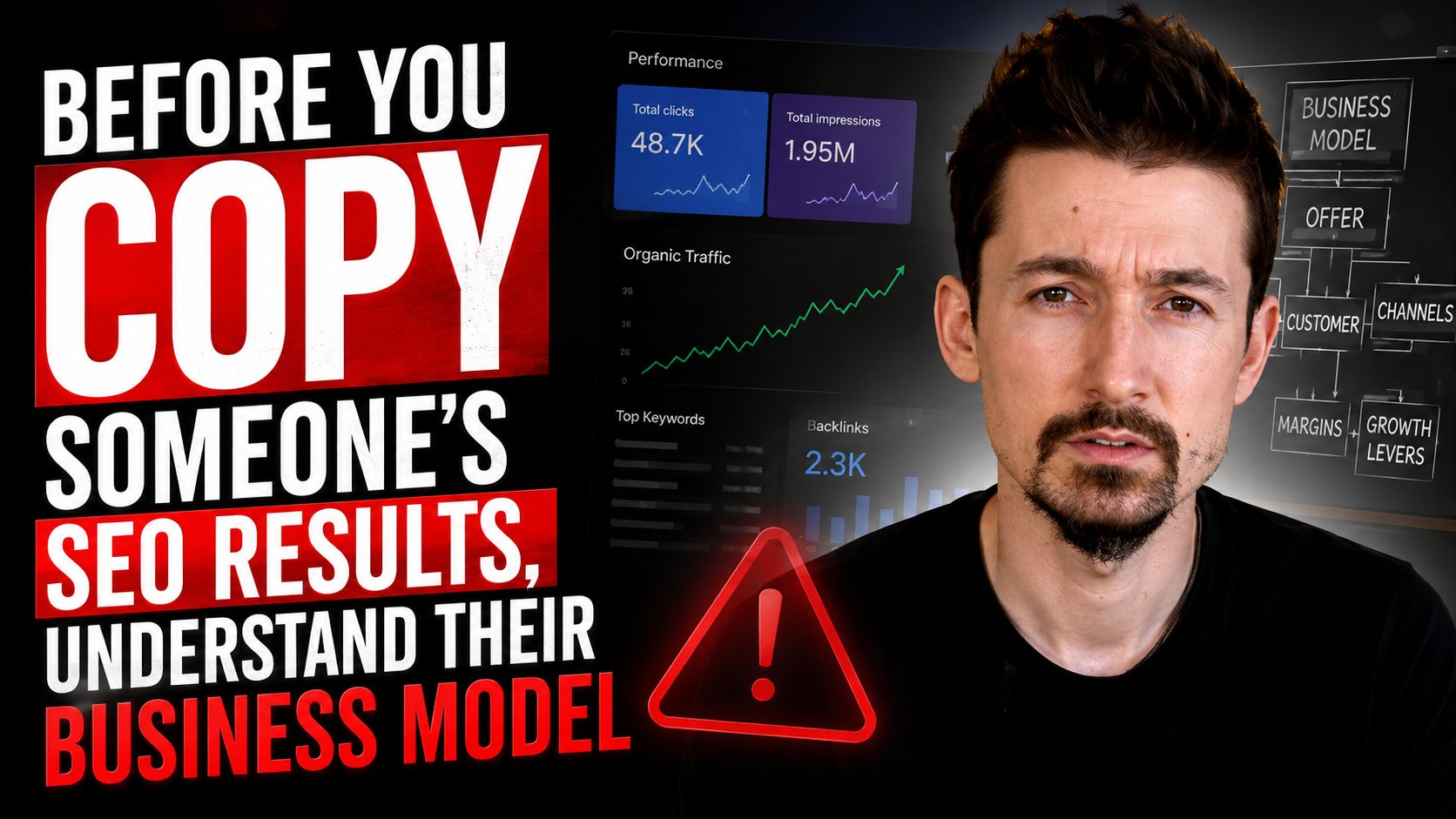
My partner sent me a case study. "Look, this guy built 10,000 pages and his traffic exploded. Let's do the same."
I started asking questions.
Turned out it was a lead gen site running on throwaway domains. Gets banned — spins up a new one. The domain itself has zero value in his model, so losing it costs him nothing. The entire strategy is built around the assumption that the asset is disposable.
We run a service business. Our domain carries years of trust, reviews, local authority built market by market. One spam penalty and we're not starting over on a new domain — we're starting over from zero, period.
That's not the same game.
Why is copying SEO tactics without copying the business model dangerous?
The SEO content you see on LinkedIn and Twitter is optimized for engagement, not accuracy. A screenshot of 10,000 indexed pages gets shares and comments. A 14-month content strategy targeting high-intent local keywords in six cities gets ignored — because it doesn't make a good screenshot.
But one of those actually builds something. The other one is a fireworks display.
The problem is that when people see a growth screenshot, they ask "how do I replicate this?" before asking "what kind of business is this, and is my situation actually comparable?"
| Business Model | Domain Disposability | SEO Risk Tolerance | Growth Speed Priority |
|---|---|---|---|
| Lead gen / affiliate | High (can swap domains) | High | Maximum |
| SaaS / software | Medium | Medium | High |
| E-commerce | Low–Medium | Medium | High |
| Local service business | Very low | Very low | Sustainable |
| Multi-location home service | Near zero | Minimal | Long-term compounding |
The tactics that 10x traffic for a lead gen operation will get a local service business deindexed in three months. Not because the tactics are universally bad — but because the risk/reward calculation is completely different when your domain is the business.
What does "Domain Authority" actually mean for a service business?
For a lead gen operator, domain authority is a tool. If it gets penalized, they build another one. The asset is the system, not the domain.
For a local service business, the domain is the asset. It carries:
- Years of Google Business Profile trust signals
- Local citation history across directories
- Backlink profile built from legitimate mentions and partnerships
- Customer review associations
- Historical ranking patterns Google has observed and rewarded
Burn that and you're not starting over with a clean slate. You're starting over with nothing — while your competitors who played the long game continue to compound their advantage.
I've watched businesses try to shortcut this. A sudden flood of templated pages. Aggressive link schemes. "Programmatic SEO" pushed to the limit. Some got away with it for 6–12 months. Then an update hit, and they were gone. Not suppressed — gone. Deindexed. And rebuilding from zero at that point is genuinely painful.
The Goal Was Never Big Numbers
Here's the thing nobody talks about: the goal was never indexed pages. The goal was never impressions. The goal was never a screenshot that looks impressive in a LinkedIn post.
The goal is booked jobs.
Indexed pages don't pay anyone's salary. Rankings don't pay anyone's salary. What matters is whether the phone rings, whether someone books a repair, whether organic traffic converts into actual revenue for the business.
| Metric | What It Shows | What It Doesn't Show |
|---|---|---|
| Indexed pages | Content volume | Whether pages are ranking or converting |
| Total impressions | Visibility | Whether impressions lead to bookings |
| Average position | Ranking level | Revenue impact |
| Total clicks | Traffic volume | Lead quality and conversion rate |
| Organic leads per day | Actual business impact | This is the only metric that matters |
I've published case studies on this blog with impression numbers that look significant — 148K impressions, 29K impressions — and I'm proud of those numbers. But the metric I actually care about is the one at the end: organic leads per day. Calls coming in. Jobs being booked. Revenue the client wouldn't have had without the content.
Everything else is a leading indicator, not the result.
The Pattern I Keep Seeing
The sharpest example of a tactic that does not transfer is hiding your business address: sensible for privacy, expensive for map-pack proximity. What it costs and how long recovery takes.
Someone posts a growth screenshot. People go crazy trying to replicate it. Nobody stops to ask what kind of business is actually behind those numbers.
Is it SaaS? Lead gen? Affiliate? E-commerce? National brand? New domain they don't mind burning?
Because the answer changes everything.
The same tactic that worked brilliantly for a lead gen operation with disposable domains is a business-ending move for a local service business that has spent years building location-specific trust. The person posting the screenshot isn't lying — they got those results. But they're not running your business, and they're not risking your domain.
Before you copy a tactic, map your situation against theirs:
| Question | Why It Matters |
|---|---|
| What type of business are they running? | Business model determines risk tolerance |
| Is their domain an asset or a tool? | Changes the entire risk calculation |
| What does "starting over" cost them vs you? | Defines acceptable failure scenarios |
| Are they optimizing for traffic or revenue? | Two different games with different tactics |
| What's their timeline — sprint or compound? | Short-term hacks vs long-term authority |
What I'm Actually Building
I don't care if my numbers look boring in a screenshot.
I care that the cities we target are calling us. I care that the content we published 8 months ago is still ranking and still generating leads. I care that when Google updates their spam detection — which they do, regularly — nothing I've built is at risk.
I'm not interested in tactics that work until they don't. I'm building domain authority that compounds. Content that answers real questions. Local trust signals that take time to build and are hard for competitors to replicate.
Slower? Yes. Less impressive in a LinkedIn post? Definitely.
But when I rank, I stay ranked. And I'm not checking Google's policy updates on Tuesday mornings hoping they didn't catch something I did six months ago.
The goal was always the same: organic traffic that converts into booked jobs, at zero ad cost, compounding month over month. That's what I build. It just doesn't screenshot well at month two.
One More Reason the Model Matters: AI Visibility
The same logic applies to AI Overviews and AI search citations. Lead gen operators chasing volume build content that is thin, duplicated, and unstructured — exactly what AI systems skip over when choosing sources to cite. A local service business with clean domain authority, structured content, and genuine specificity gets cited. The throwaway-domain operator does not.
| Content Approach | AI Citation Likelihood | Long-Term Ranking Stability |
|---|---|---|
| Throwaway domain, mass pages | Very Low | None — designed to expire |
| Template city pages, no specificity | Low | Poor |
| Structured, specific, human-reviewed content | High | Strong — compounds over time |
Before you copy a growth hack, check whether that hack makes the content better or just bigger. AI systems reward the same things Google has always rewarded — they just surface the gap faster.
If you'd rather build the citable version deliberately, the process is here: AI citation visibility. And if you want to check the result instead of assuming it, track which engines actually cite you.
If you've been tempted by a tactic that looks impressive in someone else's case study and want a straight read on whether it's appropriate for your business — let's talk. I can usually tell you in 15 minutes whether it's a fit or a risk.
Related:
- From 64 to 1,174 Pages: How I Built a Local SEO System That Drives 4-5 Organic Leads Per Day
- 35,500 to 148,000 Impressions: Why Templated SEO Gets You Nowhere
- Google's March 2026 Update and AI Content: What the Doomers Got Wrong
- Keyword Cannibalization Is Killing Your Local SEO Rankings — And Most Tools Are Making It Worse
- The SEO Strategy That Actually Worked: 14,050% Impressions Without Backlinks