I Think I Found a Repeatable Way Into AI Citations. It's Holding Across Very Different Businesses.
Let me be honest about where this sits before I show you anything: I'm still in the middle of figuring it out. I think I've found a repeatable way to get a business cited inside AI answers — the pattern is real, it's moving, and it's not luck. But it isn't a finished, bottled-and-labeled system yet, and I'd rather tell you that up front than sell you a screenshot as a solved problem.
What made me stop and pay attention wasn't one good result. It was the same approach producing AI citations across three clients in three unrelated industries at once. One win is noise. Three, in businesses that have nothing to do with each other, is the moment a hunch earns the word "method."
What am I actually seeing across these clients?
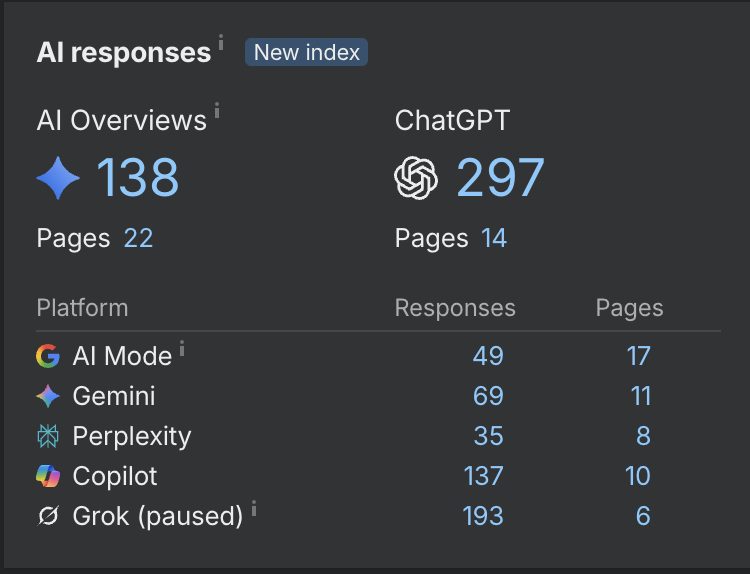
Below are three different businesses, in three different industries. Same underlying approach, three independent scoreboards. Start with the one I've measured most closely — a multi-location appliance-repair company (US), viewed across every answer engine at once:
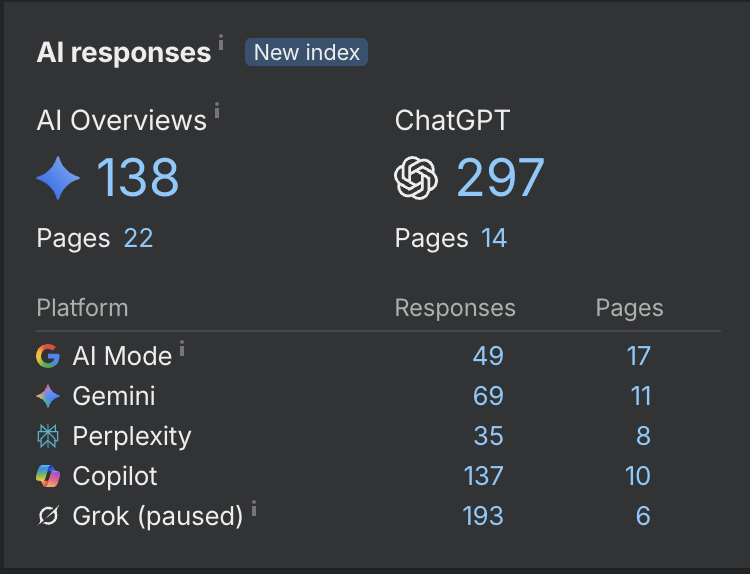
Here's that panel as a table, because the per-engine split is where the real story lives:
| Engine | Responses | Pages cited |
|---|---|---|
| ChatGPT | 297 | 14 |
| Grok (paused) | 193 | 6 |
| AI Overviews | 138 | 22 |
| Copilot | 137 | 10 |
| Gemini | 69 | 11 |
| AI Mode | 49 | 17 |
| Perplexity | 35 | 8 |
That's 725 citations across the live engines — but the number that made me lean in isn't the total, it's that the presence is spread across seven engines and pulling from as many as 22 distinct pages. That's not an accident of one viral page. That's a site being read as a source.
Does the same approach work outside one industry?
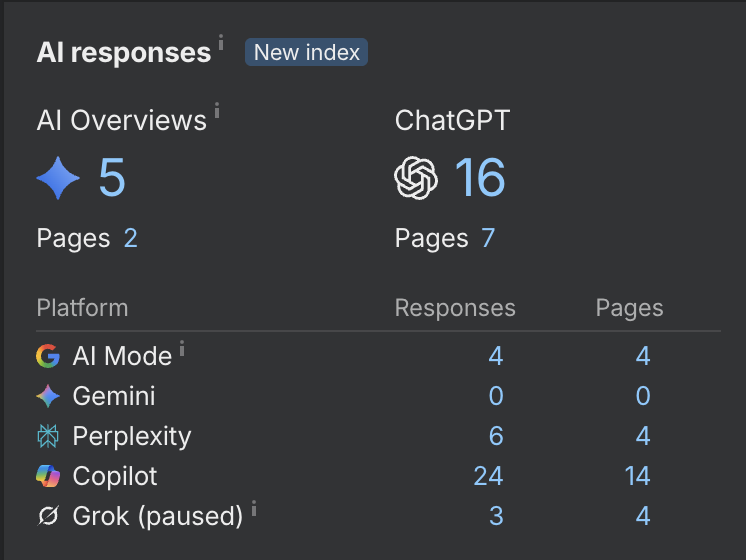
That's the whole reason I'm writing this instead of waiting. Here's a second client — a completely different industry — showing the same footprint building up:
And a third, different again:
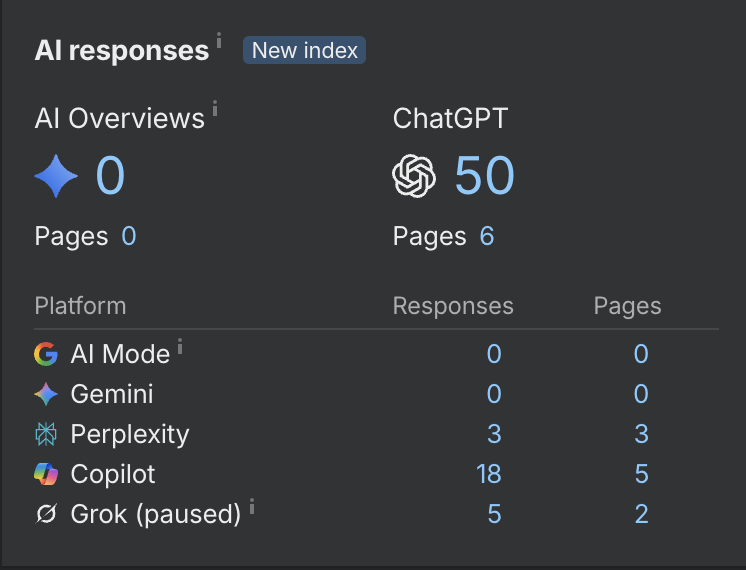
Three businesses that share no market, no customers, and no content overlap, all responding to the same structural approach. When a tactic only works in one niche, it's usually the niche doing the work. When it works across niches that have nothing in common, the tactic is doing the work. That's the distinction I've been watching for, and it's the one that flipped this from "interesting" to "worth building around."
Why am I not calling this a finished system yet?
Because presence is a leading indicator, not a proven, durable outcome — and I've watched too many people celebrate exactly this kind of chart and stop there.
A few honest caveats I keep attached to the numbers:
- The window is short. These are early snapshots, not a year of stable data.
- Grok was paused during client 1's snapshot, so its 193 is frozen — I exclude it from any growth claim rather than pretend it's live.
- The AI index itself is young. Part of any jump can be the tracking tool backfilling its own data, not purely the site gaining ground. I can't fully separate the two yet.
- Citations are not orders. Being mentioned by AI is not the same as a booked job — that gap is a separate, harder problem I've written about in Getting Cited by AI Is the Easy Part.
None of that erases the result. It just keeps me honest about what it is: a strong, repeating signal that I'm still pressure-testing.
What am I building on top of this?
This is the part I'm most invested in. Getting cited is only useful if a business can see what that presence is worth to them — and right now, most can't.
So alongside the citation work, I'm building the tooling that turns a scoreboard like the one above into something a business owner can actually act on: which engines mention you and which ignore you, which of your pages the AIs actually trust, where a competitor is showing up and you aren't, and — the hard one I'm still working — whether that presence is translating into real advantage rather than just a bigger number. The goal isn't a prettier dashboard. It's giving a business a clear, honest read on the edge its AI presence gives it, so the work is aimed at outcomes instead of vanity.
That layer isn't finished. But the reason I'm building it is sitting right there in those three screenshots: if the way in is repeatable across industries, then the way to measure the payoff is the thing worth owning.
Update, September 2026: both halves of that layer now exist. The Citation Tracker logs every AI assistant fetch on the server, per URL, separating a background crawl from a page pulled live to answer a real person — it found 813 live ChatGPT fetches in five days against 26 analytics visits in six weeks. And the attribution chain carries a visitor's first touch all the way into the job and the invoice amount in the CRM. The paragraph above stays as written, because that is what was true when it was written.
What should a business take from this today?
If your competitors are showing up in ChatGPT, AI Overviews and the rest, and you aren't, that gap is real and it's closing fast — the structural work that drives AI citations moves quicker than classic SEO. So it's worth starting now. If you're still deciding what to call that work before you buy it, I've laid out what actually separates GEO, AEO and SEO using this same measurement series.
If you would rather rent this tracking than run it, the two products people usually compare it against are broken down honestly, including where buying them beats hiring me: Profound and Peec AI.
But go in with the same clear eyes I'm trying to keep: getting cited is the fast half; knowing what it's worth to you is the half still being built. I'd rather show you exactly where that line is than pretend I'm standing past it. I'll keep running these snapshots across all three clients and update this post as the pattern either hardens into something I'll fully stand behind — or teaches me where it breaks.
Getting home service and local businesses cited by AI engines — and building the tracking to show what that presence is actually worth — is the core of my AI Citation Visibility work. If you want to know exactly where AI does and doesn't mention your business, let's talk.
Related: