Getting Cited by AI Is the Easy Part. Proving It Brings Orders Is the Real Work.
Updated 25 August 2026: the measurement layer this post said was "not finished" is now live — see the two new sections at the bottom. The first lead carrying its own origin arrived the same day.
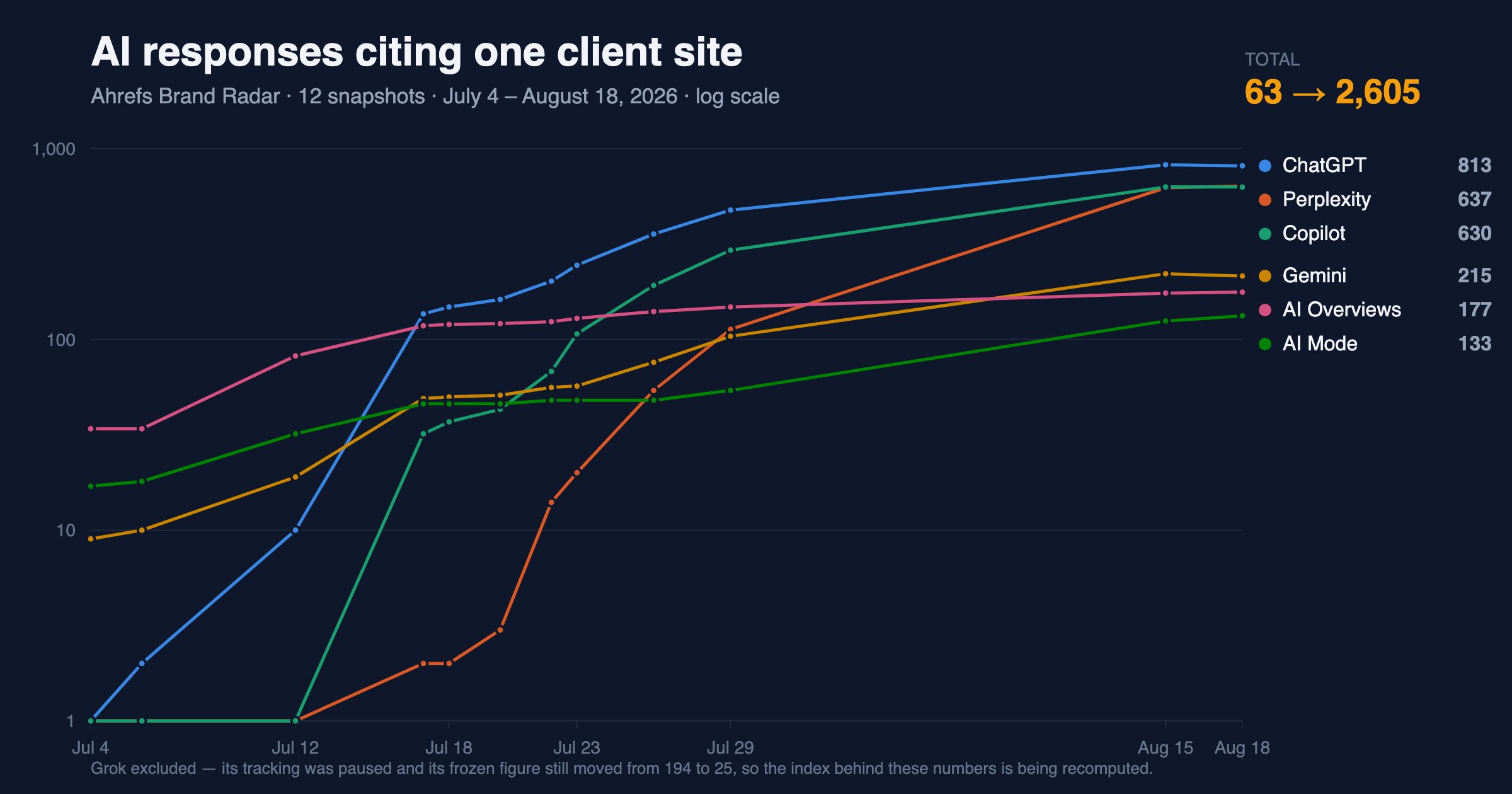
Updated 19 August 2026: the table below now runs the full series from July 4 to August 18, and the numbers are read directly off the panel snapshots rather than from memory. One correction to the original version of this post: Copilot on July 17 was 32 responses, not 33.
I've been running the same report on a multi-location appliance-repair client's site (US) every few days since early July — same tool (Ahrefs Brand Radar), same domain, same settings. Between July 4 and August 18 the site's presence in AI answers climbed across every active engine at once. ChatGPT went from citing it once to citing it in 813 responses. AI Overviews from 34 to 177.
My honest reaction wasn't "we won." It was: good, one hypothesis is working — now for the hard part.
Because I've watched too many people celebrate this exact chart and stop there. AI presence is a leading indicator, not a result. It does not pay anyone's payroll. This post is about the gap between the number that's easy to grow and the number that actually matters.
What the data actually shows
One of several bets I'm testing on this site — making it maximally readable to AI engines — is clearly moving. Every row below is one panel snapshot, responses with pages cited in brackets:
| Date | AI Overviews | ChatGPT | AI Mode | Gemini | Perplexity | Copilot |
|---|---|---|---|---|---|---|
| Jul 4 | 34 (9) | 1 (1) | 17 (8) | 9 (3) | 1 (1) | 1 (1) |
| Jul 6 | 34 (9) | 2 (2) | 18 (8) | 10 (3) | 1 (1) | 1 (1) |
| Jul 12 | 82 (16) | 10 (6) | 32 (13) | 19 (9) | 1 (1) | 1 (1) |
| Jul 17 | 118 (21) | 136 (13) | 46 (16) | 49 (11) | 2 (2) | 32 (10) |
| Jul 18 | 120 (21) | 148 (13) | 46 (16) | 50 (11) | 2 (2) | 37 (10) |
| Jul 20 | 121 (21) | 162 (13) | 46 (16) | 51 (11) | 3 (2) | 43 (10) |
| Jul 22 | 124 (21) | 202 (14) | 48 (16) | 56 (11) | 14 (5) | 68 (10) |
| Jul 23 | 129 (21) | 245 (14) | 48 (16) | 60 (11) | 20 (7) | 107 (10) |
| Jul 26 | 140 (23) | 357 (14) | 48 (17) | 76 (11) | 54 (10) | 192 (11) |
| Jul 29 | 148 (25) | 477 (17) | 54 (18) | 104 (12) | 113 (11) | 294 (11) |
| Aug 15 | 175 (26) | 824 (22) | 125 (28) | 221 (15) | 624 (19) | 631 (15) |
| Aug 18 | 177 (26) | 813 (22) | 133 (29) | 215 (15) | 637 (21) | 630 (15) |
Excluding Grok, whose tracking was paused, that's 63 → 2,605 AI responses across six weeks.
Now the part that matters more than the headline: the pages-cited column has stopped moving. It went 13 → 14 → 17 → 22 and has sat at 22 since August 15. Responses per cited page are close to saturated; the count only grows again when new pages enter the citable set. That's the actual lever, and it's invisible if you only look at the big number.
And the small dip — ChatGPT 824 down to 813 — is not a loss. Pages cited stayed at 22. Brand Radar reports responses inside a rolling sample of prompts, so a 1.3% move is sample churn. The proof is Grok: its tracking has been paused since July 12, meaning the figure is frozen, yet it reads 194, then 186, 163, 60, and finally 25. A frozen metric that falls eightfold tells you the index behind it is being recomputed retroactively. Any single-digit percentage swing here is the tool, not the site.
And that's exactly where the temptation to overclaim begins.
What the same window did to authority and organic
If AI visibility were just a shadow of link building, these two tables would move together. They don't:
| Date | DR | Backlinks | Ref. domains | Organic keywords | Organic traffic |
|---|---|---|---|---|---|
| Jul 4 | 3.1 | 323 | 294 | 113 | 510 |
| Jul 18 | 2.8 | 346 | 318 | 133 | 512 |
| Jul 29 | 4 | 410 | 380 | 152 | 1.2K* |
| Aug 18 | 7 | 490 | 461 | 181 | 621 |
For the first two weeks the split is stark: AI responses grew roughly 6x while DR actually fell from 3.1 to 2.8 and organic traffic sat flat at ~510. Whatever was moving the AI numbers in that window, it wasn't authority.
Over the full six weeks I have to be straighter than that. Authority did rise — DR 3.1 to 7, referring domains 294 to 461 — so the clean decoupling story only holds for the first fortnight. What holds across the whole window is the ratio: AI responses up ~41x against organic traffic up ~22%. That ratio is the cleanest evidence I have that this is separate work rather than a rebrand, and I've used it to draw the line between GEO, AEO and classic SEO — including where the three still depend on each other.
*Ahrefs switched to a new organic-traffic model during this window (the change was announced in-panel on August 18), so traffic estimates are not strictly comparable end to end. The late-July 1.2K reading sits inside that change.
Why is "AI presence" the wrong number to celebrate?
Because presence measures whether AI mentions you — not whether that mention sent you a paying customer. Those are two completely different things, and the distance between them is where most AI-SEO stories quietly fall apart.
A citation count going up feels like progress because it's visible, it's a big number, and it makes a great screenshot. But it's a vanity metric until you can tie it to something downstream. The trap is identical to the one I see everywhere in local SEO: businesses obsess over impressions, rankings, and citation counts — the numbers that are easy to see — instead of the number that's hard to see and actually matters: did orders go up because of this?
Presence is necessary. It is not sufficient. Being in the AI answer is step one. Being the business the customer then chooses is a different problem entirely.
Why is it so hard to track orders from AI citations?
Because AI search is a near-invisible funnel — the industry calls it the "dark funnel" — and almost none of it shows up in your analytics the way a Google click does.
Here's what breaks normal attribution:
- No referrer. When ChatGPT or Gemini names a business in an answer, the user often reads it and acts without clicking a tracked link. There's no clean "source = ChatGPT" row in your analytics.
- Brand-search laundering. The most common path is: user asks AI → AI mentions the brand → user Googles the brand name → clicks → converts. Your analytics credits "organic branded search." The AI answer that started it is invisible.
- Multi-touch reality. A customer might see you in an AI answer, a map pack, and a friend's recommendation before calling. Which one gets the credit? All of them, and none cleanly.
- Offline conversion. In home services the order is usually a phone call, not a web checkout. The trail goes cold the moment they dial.
So you can grow AI presence 41x and have essentially no native way to prove it drove a single job. That's not a reason to ignore it — it's the reason it's genuinely hard, and why "citations went up" is where the easy work ends.
How do you actually track orders from AI, then?
You can't get a perfect number, but you can build a defensible one by triangulating several imperfect signals instead of trusting any single dashboard:
- Brand-search lift. Watch branded-query impressions and clicks in Search Console. If AI presence is working, more people should be searching the business by name over time. It's indirect, but it's the clearest fingerprint of the dark funnel.
- Ask at the point of sale. A "How did you hear about us?" field at booking — with an explicit "ChatGPT / AI assistant" option — is crude but it's real first-party data most businesses never collect.
- First-touch capture. Where you control the site, log the first channel a lead arrived from, not just the last one, so branded search doesn't steal all the credit.
- Correlation over time. Line the citation-growth trend up against lead volume across a long-enough window. Correlation isn't proof, but a consistent lag pattern is a strong signal — and it's honest about being a signal, not a certainty.
Anyone who tells you an off-the-shelf dashboard can cleanly attribute revenue to AI citations today is selling something. When this post first went up, my own version of that layer wasn't finished either. As of August 25 it is — the two sections below are what it found in its first week.
What the server sees that analytics doesn't
Before trusting any click-based number, I put a passive counter on the server itself — the Citation Tracker, which does nothing but write a line every time a known AI crawler or assistant requests a page, classified by whether it was crawling, training, indexing or fetching the page live to answer somebody. Five days of raw output, grouped by agent:
| Agent | Requests in 5 days | What it is |
|---|---|---|
| Meta (external agent) | 1,778 | background crawl |
| ChatGPT (live user requests) | 813 | a page fetched while answering a real person |
| Perplexity (index) | 704 | background crawl |
| Amazonbot | 490 | background crawl |
| OpenAI search crawler | 178 | search index |
| Claude (index) | 122 | background crawl |
| GPTBot (training) | 118 | training corpus |
| Bytespider | 68 | background crawl |
| Claude (live user requests) | 49 | live answer fetch |
| Perplexity (live user requests) | 19 | live answer fetch |
Five days, because that's exactly how long this counter survived its first run — it went up on July 18 and was taken down on July 23 during unrelated server maintenance. It was reinstalled on August 25 and is collecting again; the five days above are the complete first sample, not a slice of something longer. The second sample now covers two sites and 6,676 requests, and I've written up what it does and doesn't prove — including one file the logger cannot see by design.
The row that matters is the bold one. 813 times in five days, ChatGPT pulled a page from this site in the middle of answering someone's question. (One coincidence worth naming so it doesn't look like a recycled number: the Brand Radar snapshot of August 18 also happens to read 813 for ChatGPT — but that's six weeks of cited answers in an external index, while this is five days of server requests in my own log. Two different instruments landed on the same number by chance.) Now the other side of the ledger: across the entire six-week window, analytics recorded 26 visits from all AI platforms combined — ChatGPT, Gemini, Claude, Perplexity and Copilot together.
Hundreds of answers a week, a handful of clicks. The customer gets the answer — and in home services, the phone number — inside the chat, and never touches the site. This is the dark funnel measured from the inside, and it's why every click-based AI report understates what's actually happening by two orders of magnitude.
The first lead with an origin
On August 25 the full attribution chain went live: every visitor now carries a durable mark of where they first came from, and that mark survives — through return visits, through brand searches, through the days between reading an answer and finally submitting a request — all the way into the lead itself, next to the customer's phone number. And the phone number is the key that opens the CRM, where a job has a dollar amount.
The same day, the first real lead arrived with its origin attached. Not "direct traffic". Not "(not set)". The actual first touchpoint, visible in the order.
How the chain is built is my kitchen. What it produces is the number this post has been about from the first paragraph: how much booked revenue came out of 2,605 AI citations. I'll publish it in about a month, whatever it turns out to be. If it's zero, I'll publish zero — that's the difference between measuring and selling.
The honest caveats
Six weeks of data on one site proves less than the size of the numbers suggests. What this is not:
- Ahrefs' AI index is itself new — every snapshot carried a "New index" badge, so part of the climb is the tool expanding and backfilling its own coverage, not purely the site gaining ground. I can't separate the two, and I won't pretend the split is knowable from here.
- A frozen number moved. Grok's tracking was paused on July 12 and its figure still travelled from 194 to 25. That is direct evidence of retroactive recomputation in the dataset I'm measuring with.
- Engines I did no work for grew just as hard. Perplexity went 1 to 637 and Copilot 1 to 630. Nothing in the plan targeted either. When surfaces that got no attention move like the ones that did, index expansion is the more parsimonious explanation than earned visibility.
- The models are not deterministic. On this same site, 71 pairs of near-identical questions — one word or a synonym apart — landed on opposite sides of being cited. Individual results are a lottery; only the rate across a large set means anything.
- One site, one niche, one tool. No control group. I ran the same approach on two other domains and did not get this curve, which says more about how much the niche and the domain decide the outcome than about the tactics.
- Presence ≠ orders, which is the whole point of this post. Until the attribution layer is built and running, the citation growth is a promising input, not a business result.
What does this mean for a home service business?
If a competitor is showing up in ChatGPT and AI Overviews and you aren't, closing that gap is worth doing — the on-page and structural work that drives AI citations is real and it moves fast. But go in clear-eyed: getting cited is the cheap, fast half. The valuable, slow half is building the measurement to know whether that presence turns into booked jobs — and being honest with yourself when the data isn't in yet.
I'm a step closer to answering that on this site. Not there. And I'd rather tell you exactly where the line is than sell you a screenshot.
I'll keep re-running the report and update this post as the trend — and, more importantly, the order data — either backs it up or doesn't.
Making home service sites readable and quotable by AI engines is half of my AI Citation Visibility work — the other half is building the tracking to prove it drives real jobs, not just mentions. If you want both halves done right, let's talk.
Related:
- 600 Out of 7,801: The Silent Bug That Booked Jobs on Techs Who Were Off
- I Stopped Chasing Startup Ideas and Started Collecting Business Pains
- You Don't Have a Lead Problem. You Have a Conversion Problem You Can't See.
- Google AI Overviews: What Home Service Businesses Need to Know in 2026
- Getting Into AI Citations: A Repeatable Method