You Don't Have a Lead Problem. You Have a Conversion Problem You Can't See.

Most home service owners who run on Local Services Ads think they have a lead problem.
Usually they have a conversion problem they can't see.
Here's the pattern: the business pays $50–60 per lead, volume looks reasonable, but revenue isn't following. The assumption is always the same — "get me more leads." So everyone optimizes the top of the funnel. More ad spend. More clicks. More calls.
Meanwhile, the actual money keeps leaking somewhere nobody is looking.
The Leak Is After the Phone Rings
Those expensive, already-paid-for leads come in. And a chunk of them get lost on the call.
Weak objection handling. A quoted price with no framing. A "let me check and call you back" that never actually calls back. The lead was valid. Google charged for it. The owner paid $55. And it still didn't turn into a booked job.
Everyone tracks Cost Per Lead. Almost nobody tracks Cost Per Lost Booking.
Those are very different numbers with very different implications.
| Metric | What It Tells You | What It Misses |
|---|---|---|
| Cost Per Lead | How much you pay to get a call | Whether the call turned into a job |
| Lead volume | How many calls came in | How many should have booked but didn't |
| Conversion rate (total) | Booked ÷ total leads | Where in the process leads dropped off |
| Cost Per Lost Booking | What each failed call actually cost | This is the number almost nobody calculates |
The Math That Wakes People Up
Say you're paying $55 per LSA lead. You get 100 leads per month. 40 book. 60 don't.
The industry assumption is that those 60 lost leads were bad leads — wrong service, wrong area, not ready to buy. Some of them were. But based on call analysis I've run on real accounts, a significant portion of those "lost" leads were viable customers who called with a real problem and left without booking because of what happened on the call, not because of anything wrong with the lead itself.
If even 15 of those 60 lost leads could have been saved with better call handling:
| Scenario | Lost Bookings Recovered | Revenue Impact (avg $250/job) | Monthly Gain |
|---|---|---|---|
| Conservative (10% recovery) | 6 jobs | $1,500 | $1,500/month |
| Moderate (25% recovery) | 15 jobs | $3,750 | $3,750/month |
| Strong (40% recovery) | 24 jobs | $6,000 | $6,000/month |
All of that without spending an extra dollar on ads.
What is actually happening on those calls?
Four failure patterns, and none of them are about price. After pulling and analyzing call recordings on a real LSA account, the calls that didn't book failed the same four ways: the close was left to the customer, a price question was refused instead of answered with a range, a dropped line was never called back, and an after-hours call went to voicemail nobody returned.
Here is what that looked like line by line:
| Call Failure Pattern | What Was Said | What Should Have Happened |
|---|---|---|
| Passive close | "Let me call you back." → "Okay, thank you." | "I can hold this time slot — when can you confirm?" |
| Price refusal | "How much does it cost?" → "We can't quote without seeing it." | Give a range + context + move toward scheduling |
| Dropped call | Line drops → nobody calls back | Call back within 2 minutes |
| Unresolved objection | Customer hesitates → silence → call ends | Acknowledge the concern, address it directly |
| No next step | Good conversation → vague close | Specific day, specific time, confirmation |
None of these require a new sales training program. They're basic call handling practices. The gap is that nobody is watching for them systematically.
The Real Account
I ran into this on a real LSA account. Volume looked fine — enough calls were coming in, spend was climbing, but revenue wasn't following. For months, the assumption was "we need more leads."
So instead of adding budget, I pulled the actual call recordings. Transcribed them. Marked every call where a booking was on the table and didn't happen. Measured the rate.
The bottleneck wasn't traffic. It was the handoff between paid lead and booked job — the 90 seconds on the phone after the customer called and before they either booked or didn't.
Once that got addressed, the account turned a heavy monthly loss into break-even for the first time in half a year. Not from buying more leads. From stopping the bleed on the ones already paid for.
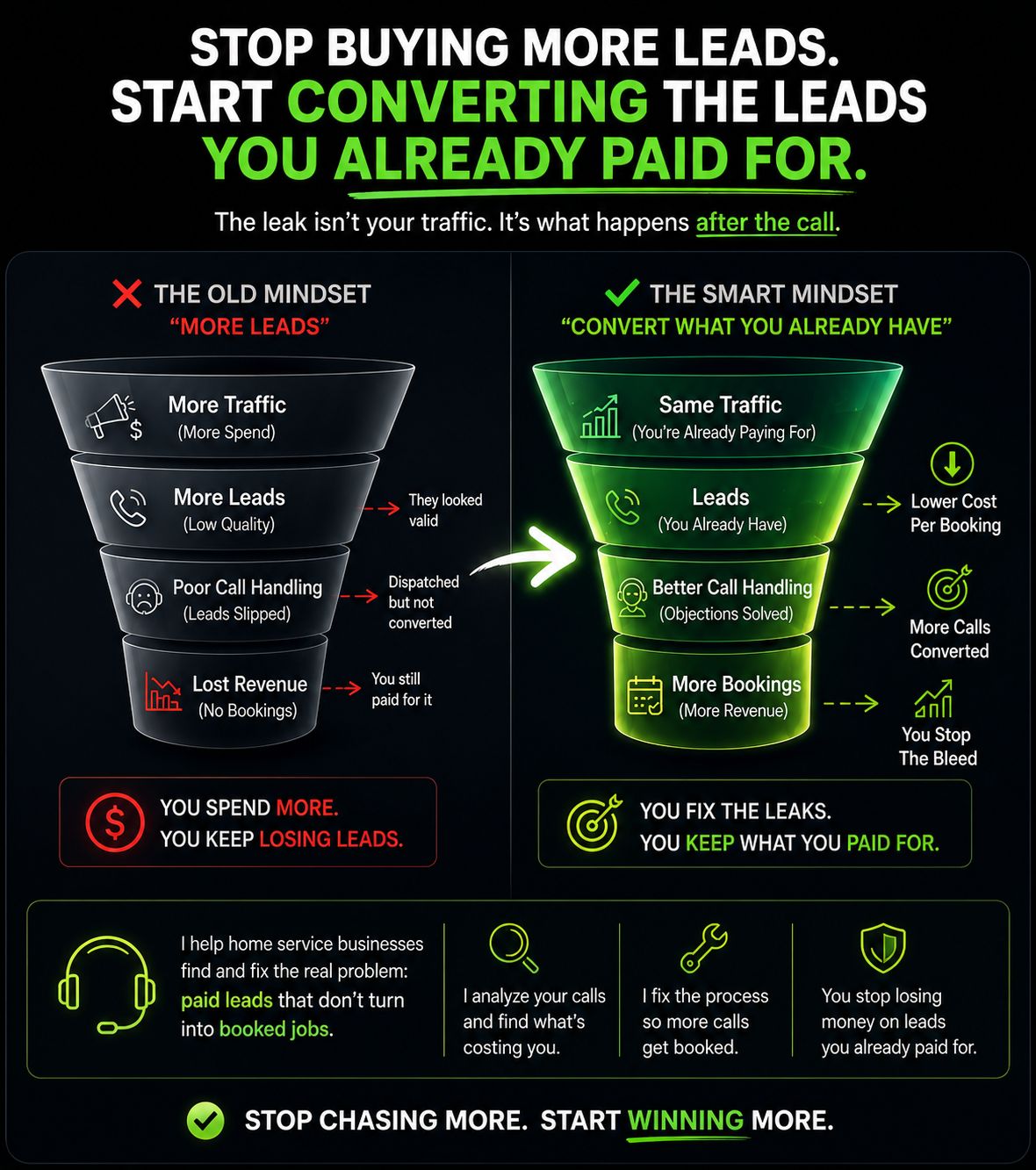
The Two Funnels
Before fixing the conversation, it is worth removing the leads that were never real: the invalid ones you were charged for. That is a separate, mechanical recovery, described on LSA recovery.
Most businesses operate on the left side of this without realizing it:
| The "More Leads" Mindset | The "Fix the Leak" Mindset |
|---|---|
| Increase ad spend | Same spend |
| More calls come in | Same calls |
| Poor call handling → leads slip | Better call handling → objections solved |
| Lost revenue — you still paid for it | More bookings, more revenue |
| You spend more, you keep losing leads | You fix the leaks, you keep what you paid for |
The business on the right didn't get more traffic. It got better at converting the traffic it was already paying for.
How do you find your conversion problem?
You can't fix what you can't see. The first step is making the invisible visible.
Step 1 — Pull your call recordings. Every LSA account has them. Most business owners have never listened to more than a handful.
Step 2 — Define what "should have booked" looks like. A call where the customer had a real problem, was in your service area, asked about scheduling or pricing, and still didn't book is a lost booking — not a bad lead.
Step 3 — Count them. What percentage of your calls fit that profile? Even a rough number changes the conversation.
Step 4 — Look for the pattern. Is it price objections? Is it passive closes? Is it dropped calls? Usually one or two patterns account for the majority of lost bookings on a given account.
Step 5 — Fix the specific pattern. Not "train your dispatchers to be better" — "when a customer says X, here's what to say next."
At scale, I do this with AI call analysis — pulling recordings automatically, transcribing with Whisper, and feeding transcripts to Claude to identify patterns across hundreds of calls at once. That same transcript pass is what drives LSA lead recovery: the calls that never were real customers get disputed, the calls that were get fixed. The dispute half of it — what Google credits per category and how the filing runs at volume — is disputing LSA credits at scale. But even doing it manually on 20–30 calls will show you more than most businesses have ever seen about what's happening after the phone rings.
What This Means for Your LSA Budget
If you're running on LSA and the numbers don't add up despite "enough leads," the problem might not be where you're looking.
Before increasing your daily budget, calculate what a lost booking actually costs you. Not just the lead fee — the lost revenue from a job that should have been yours.
At $55/lead and $250/job, every unnecessary lost booking costs you $305 in total: $55 you paid and $250 you didn't earn. If you're losing 20 of those a month, that's $6,100 walking out the door.
That number tends to wake people up.
I analyze LSA call recordings to find exactly where bookings are being lost and what's causing it — then help fix the specific patterns. If your revenue isn't matching your lead volume, let's talk.
Related: