How to Dispute LSA Credits at Scale: $13,000+ Recovered in One Cycle

Google charges you for LSA leads that were never real customers.
Wrong service area. Spam calls. Someone who called about something you don't do. Google's own policy allows you to dispute all of it and get a credit. Most businesses pay anyway.
Not because they don't know disputes are possible. Because doing it properly doesn't scale.
How do you dispute LSA credits?
Open the lead in the Local Services Ads dashboard, click into the charge, and file it under one of Google's own categories: wrong service, outside service area, spam or robocall, or duplicate charge. Each dispute needs the reason to match what the call actually was, which is why the evidence — the recording or the transcript — decides the outcome, not the wording. Google reviews it and credits the charge back if the reason holds. Nothing about that is hard; what breaks is volume. At 30–50 charged leads a month per location it is hours of listening every week, and across ten locations nobody does it consistently. The rest of this post is what happens when that pass is automated instead: $13,000+ credited back in one cycle.
Why do most businesses not dispute LSA leads?
Disputing an LSA lead correctly means:
- Going through every charged lead individually
- Listening to or reading what actually happened on the call
- Determining whether it meets Google's dispute criteria
- Filing each dispute one at a time in the LSA dashboard
For a single-location business getting 30–50 leads per month, that's already a significant time commitment. For a multi-location operation running across 5, 6, or 10 markets — it's hours of mind-numbing work every week that nobody actually does consistently.
So most businesses eat the cost. They accept that some percentage of their LSA spend is waste, chalk it up to the cost of doing business with Google, and move on.
That waste is larger than most people realize.
What will Google actually credit?
Google's dispute policy covers more than most LSA advertisers know:
| Dispute Category | What Qualifies | Common Example |
|---|---|---|
| Wrong service | Call is for a service you don't provide | Plumber charged for electrical inquiry |
| Wrong area | Caller is outside your service area | Job location 40 miles outside coverage |
| Spam / robocall | Automated or clearly non-human call | Robocall, dead air, obvious spam |
| Duplicate charge | Same lead charged multiple times | Same caller, same issue, billed twice |
| Not a service request | Call has nothing to do with your business | Wrong number, personal call, solicitation |
| Already a customer | Existing customer calls, charged as new lead | Repeat client billed as acquisition |
Every one of these is a legitimate dispute ground under Google's own policy. Every one of these is money back in your account. Most businesses are letting all of it go because catching them manually doesn't scale.
The System I Built
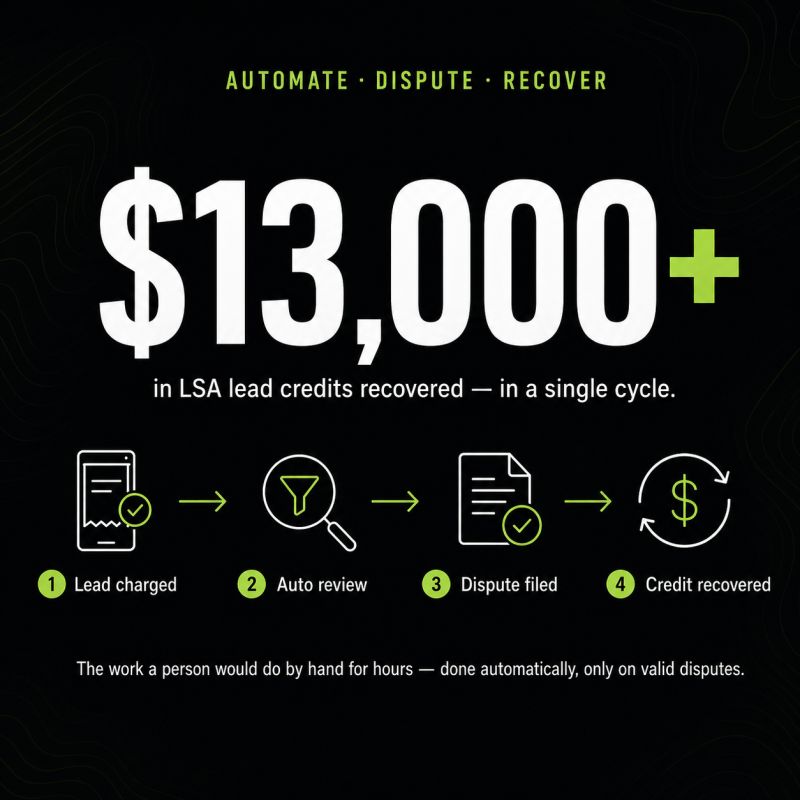
The system runs four steps automatically:
1. Pull charged leads — connects to the LSA account and pulls every charged lead from the billing period
2. Auto review — reads the call transcript for each lead (via Whisper transcription + Claude analysis) and checks it against dispute criteria: service match, geographic match, call quality, conversation content
3. File disputes — where the transcript shows valid grounds, files the dispute automatically with the appropriate category and supporting context
4. Track credits — logs every dispute filed and monitors which ones result in credits
The work a person would do by hand for hours — done automatically, only on valid disputes. No gaming. No mass-filing junk. The system applies the same judgment a careful human reviewer would apply — it just does it across every single lead instead of the handful a person gets to before giving up.
The Result
Across several multi-location home service accounts in one mid-2026 dispute cycle: $13,000+ in LSA lead credits.
| Metric | Value |
|---|---|
| Accounts covered | Multiple multi-location home service accounts |
| Dispute cycle | One monthly billing period, mid-2026 |
| Credits on the account | $13,000+ |
| Disputes filed | Valid grounds only — no junk filings |
| Manual work required | None after setup |
What is a credit, exactly? It is not your money back
This is the part that gets oversold in this category, so here it is plainly. A credit is advertising credit inside the Local Services Ads account. It reduces what the platform charges you for future leads. It does not arrive in your bank account, you cannot withdraw it, and if you shut the LSA account down, whatever is unspent goes with it. Money that goes into that platform stays in it.
So the honest description of this work is not "we get your money back". It is: you stop paying twice for leads that were never customers, and next cycle costs less. For a business that is going to keep buying leads anyway, that is worth real money. For a business planning to leave the platform, it is worth much less — and that is a legitimate reason not to hire anyone for this.
One more caveat on reading the number above: what the LSA screen shows is the credit balance within a billing cycle, not a running total of everything ever credited. Snapshots from different dates cannot be added up or compared directly, which is why the figure here is stated per cycle rather than as an all-time recovery.
And the approval rate is not stable
An earlier version of this post quoted a rough approval rate as if it were a property of the system. It is not — it is a property of the platform's policy in a given period, and that policy moves.
In a later cycle on the same account, measured from the platform's own charge-status export rather than from my own logs: 3,614 filings produced 14 credits. Same tool, same filing criteria, same account, and I told the client to stop running it. The automation was never the variable. If someone quotes you a fixed approval rate for LSA disputes, they are quoting a period they were lucky in.
What does disputing at scale actually mean?
For a single location, manual disputing is annoying but doable. Most attentive owners or managers can get through a month's leads in an hour or two if they prioritize it.
For multi-location operations, the math breaks down:
| Locations | Avg Leads/Month | Time to Manually Review All | Time Per Week |
|---|---|---|---|
| 1 | 50 | ~2 hours | ~30 min |
| 3 | 150 | ~6 hours | ~1.5 hours |
| 6 | 300 | ~12 hours | ~3 hours |
| 10 | 500 | ~20 hours | ~5 hours |
At 6 locations, you're talking about a dedicated part-time job just to review leads for dispute eligibility. Nobody does this. So the disputes don't get filed. And Google keeps the money.
The automation makes the 6-location case take the same effort as the 1-location case: setup once, run monthly, review the dispute log.
The Transparency Part
Before anyone asks — because this question comes up — here's the full context.
Every dispute filed by this system was filed only where the call showed valid grounds under Google's own policy. The system isn't looking for loopholes. It's applying the same criteria a careful human reviewer would apply: does this call represent a genuine service request in the right area for the right service?
If yes — no dispute. If no — dispute filed with the appropriate category.
The difference between this and doing it manually isn't the judgment. It's the coverage. A person reviewing 20 calls out of 300 might recover some credits. A system reviewing all 300 recovers what's actually there.
If You're Running LSA Across Multiple Locations
You are almost certainly overpaying Google every month. Not because of fraud or errors on your end — because the manual dispute process doesn't scale to multi-location operations, and the money you're owed stays with Google by default.
The fix isn't complicated. It requires systematically reviewing every charged lead against dispute criteria and filing where there are grounds. That's it. The hard part is the scale — and that's the whole reason I packaged this as LSA lead recovery: every charged lead reviewed against Google's own dispute criteria, not a sample.
If you're running LSA across multiple locations and want to know what your current dispute gap looks like — how much you might be leaving on the table — let's talk. I can audit your last billing cycle and give you a concrete number.
Related:
- You Don't Have a Lead Problem. You Have a Conversion Problem You Can't See.
- I Analyzed 100 Service Business Calls With AI. What I Found Was Uncomfortable.
- 3 AM, Database Down, AI Bot Dead: What I Learned From My Worst Night in Automation
- From 64 to 1,174 Pages: How I Built a Local SEO System That Drives 4-5 Organic Leads Per Day