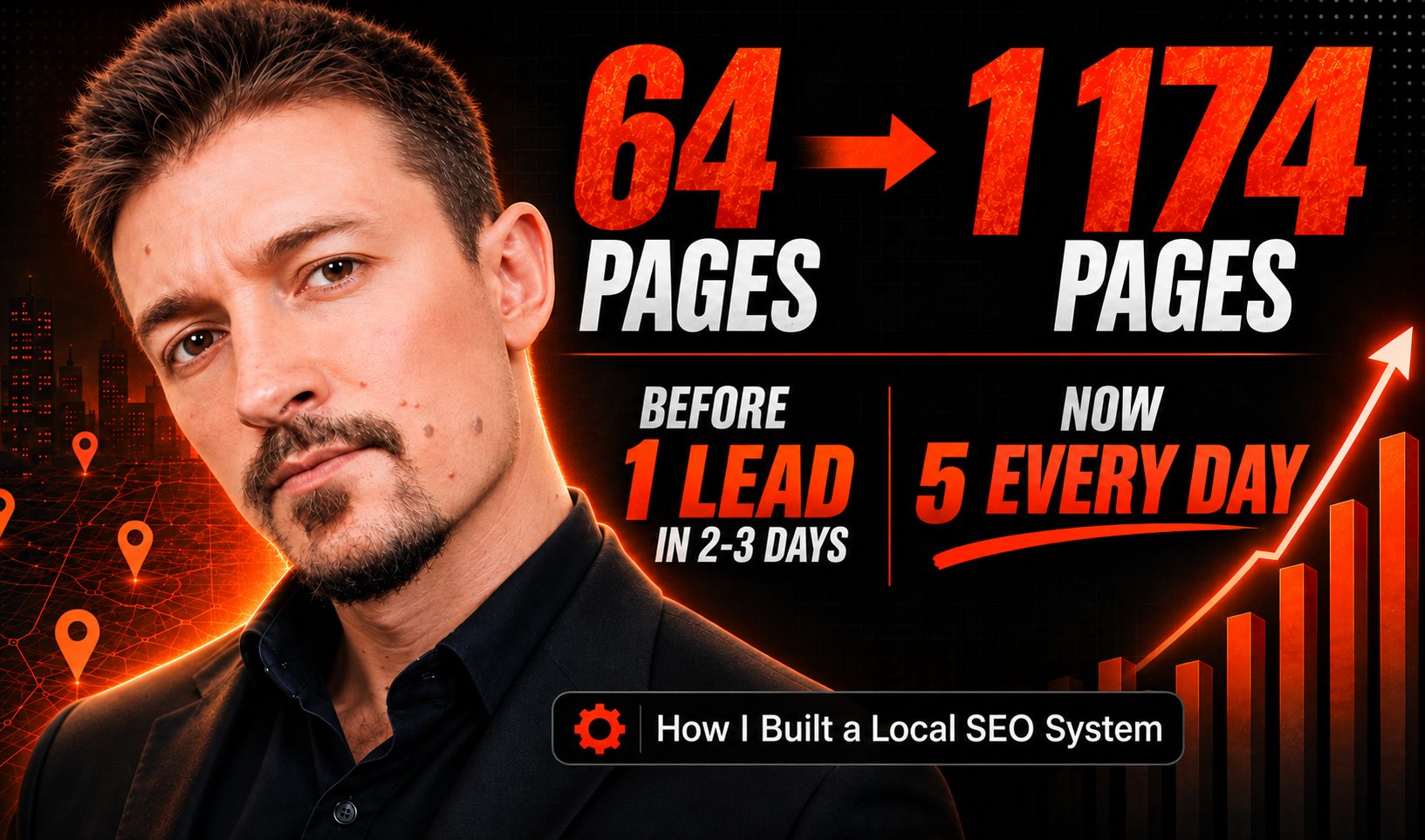
From 64 to 1,174 Pages: How I Built a Local SEO System That Drives 4-5 Organic Leads Per Day Across 6 Cities
Let me start with the elephant in the room.
When I was building this system, LinkedIn was full of SEO "experts" declaring that AI-generated content would destroy your rankings. Google would penalize you. Everything would collapse.
Twelve months later: 1,174 indexed pages, 962K impressions, 9,728 clicks, 4-5 organic leads per day. No penalties. No collapse.
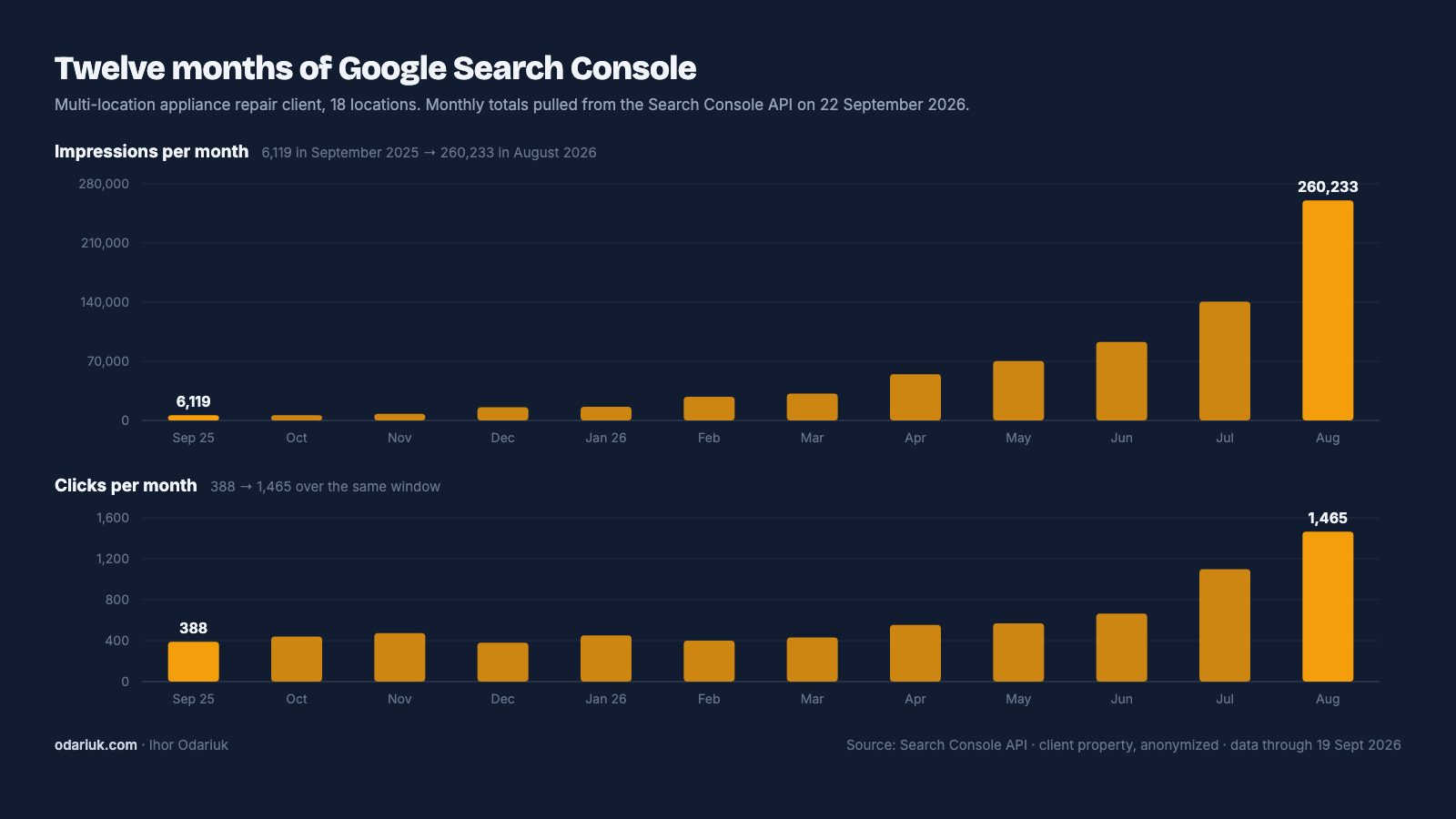
Figures refreshed 22 September 2026, pulled from the Search Console API (data through 19 September) rather than read off a dashboard. Over the trailing sixteen months the account reads 961,997 impressions and 9,728 clicks at average position 10.4. Month against month: September 2025 produced 6,119 impressions and 388 clicks at position 16.2, and August 2026 — the last complete month — produced 260,233 impressions and 1,465 clicks at position 9.0. The six months to date account for 838,495 impressions against 98,712 in the six months before them, so the curve got steeper after this case study was first written, not flatter. What that growth did and did not prove about booked revenue is the subject of a separate piece on the attribution gap.
The people making those predictions weren't wrong that bad AI content fails. They were wrong about what bad means. Bad content is content that doesn't help the reader — regardless of who or what wrote it. If you use AI as a word-count machine with a keyword stuffed prompt, yes, it'll fail. If you use it as a writing accelerator with human oversight at every step, it works exactly like good human writing works.
This is the story of how I built a system that scaled across 18 locations without sacrificing quality — and what the numbers actually look like.
The Starting Point: September 2025
The client: a multi-location appliance repair company serving 18 locations.
The situation when I took over:
| Metric | Starting Point (Sept 2025) |
|---|---|
| Indexed pages | 64 |
| Monthly impressions | Low / unmeasured |
| Organic clicks | Minimal |
| Organic leads per day | ~1 |
| Physical storefront on Maps | None (service-area business) |
| Content strategy | None |
| Local landing pages | None |
That last point about the physical storefront matters more than most people realize. A business with a verified Google Maps pin — a restaurant, a retail store, a clinic — gets Local Pack visibility almost by default if they do basic optimization. A service-area business that travels to customers has no pin. No Local Pack shortcut. The only path is organic content ranking.
This is one of the hardest starting positions in local SEO. Which is exactly why the results are worth documenting.
Why does most multi-location SEO fail?
One structural handicap sits underneath all of it for service-area businesses: a hidden address costs map-pack proximity, and recovery is measured in months. What that actually costs.
Before getting into what I built, it's worth understanding why the standard approach doesn't work.
Most agencies or freelancers handling multi-location SEO do one of two things:
Option A — City page templates. They create one page template, swap the city name, and publish 50 identical pages with "Appliance Repair in [City]" as the H1. Google sees thin duplicate content. Rankings stay flat.
Option B — One strong page, no local depth. They optimize a single service page well but don't build out the geographic coverage. Traffic is limited to people searching without a city modifier.
Neither approach captures the long tail of local search — the zip code level, the neighborhood level, the specific service + specific area combinations that make up the majority of actual local searches.
| Approach | What It Captures | What It Misses |
|---|---|---|
| City template pages | "Appliance repair [City]" | Zip codes, neighborhoods, specific services |
| Single optimized page | General service terms | Any geographic specificity |
| Zip code + service matrix | Long-tail local searches | (Nothing — this is the goal) |
| AI Overview blocks | Featured snippet / AI citation | (Covered separately with schema) |
The System I Built
1. Service-Area Pages at Zip Code Level
Instead of one page per city, I built pages for every significant zip code in each service area. Each page covers 6 specific services for that location.
The math: 18 locations × multiple zip codes per location × 6 services = hundreds of pages, each targeting a specific geographic + service combination.
This is why the page count went from 64 to 1,174. Not padding — genuine coverage of the search surface.
Scaling this way has one built-in risk: zip code pages, city pages and root service pages start competing for the same queries. Before adding pages at this volume, map which URL owns which intent — that mapping is exactly what a service area cannibalization audit produces.
2. AI Overview-Optimized Opening Block
Every page opens with a 4-sentence block written specifically to match what Google shows in AI Overviews and featured snippets.
The format:
- Sentence 1: Direct answer to the implied question ("What appliance repair services are available in [area]?")
- Sentence 2: Specific services listed
- Sentence 3: Service-area clarification (no storefront, we come to you)
- Sentence 4: How to get started
Human tone throughout. No SEO filler. Written the way a competent technician would explain their service to a neighbor.
This block is what gets cited in AI Overviews. Structured, specific, answerable.
3. Real Local Specificity (Not Template Swaps)
The difference between a template page and a real local page is specificity that couldn't apply anywhere else.
For each area I included:
- Local landmarks and neighborhoods as reference points
- Service coverage radius from that zip code
- Any area-specific notes (parking, access, common appliance brands in that market)
- Response time realistic to that geography
A reader in that zip code should recognize their area in the content. Google's quality signals pick this up through engagement metrics — time on page, return visits, low bounce rate.
4. Internal Linking Architecture
Every service page links to:
- Related services in the same geographic area
- The main city hub page ("back to [City] appliance repair")
- The most relevant FAQ content
This serves two purposes: users never hit a dead end, and Google can crawl the full content graph efficiently. PageRank flows from the hub pages down to the zip code pages and back up.
5. Schema Markup on Every Page
Full LocalBusiness schema with service area definitions. FAQPage schema on every page that includes Q&A content. No exceptions.
Schema doesn't guarantee rankings. But it gives Google structured data to pull into Knowledge Panels and AI Overviews — which matters for a service-area business that can't rely on a Maps listing.
Tools used: Google Search Console, RankMath. No Ahrefs. No SEMrush. No BrightLocal. No paid SEO tools.
The Results
| Metric | Sept 2025 | Aug 2026 | Change |
|---|---|---|---|
| Indexed pages earning impressions | 27 | 1,174 | 43× |
| URLs in the sitemap | 64 | 1,173 | +1,733% |
| Monthly impressions | 6,119 | 260,233 | 43× |
| Organic clicks | 388 | 1,465 | 3.8× |
| Average position | 16.2 | 9.0 | page two → page one |
| Organic leads per day | ~1 | 4–5 | +400% |
| Equivalent ad value per day | ~$50 | $150–250 | ~4× |
Both traffic columns are single calendar months pulled from the Search Console API on 22 September 2026, not running totals — August 2026 is used because it is the last complete month. "Indexed pages earning impressions" counts distinct URLs that Google actually showed to someone in that window, which is a stricter test than a page being technically indexed.
I also ran the URL Inspection API over every one of the 1,173 URLs in the sitemap the same day, because "indexed" is a word most case studies use without checking: 1,103 come back as "Submitted and indexed" — 94%. The remaining 70 split into 33 crawled but not indexed, 26 Google has never heard of, and 11 discovered and queued. That residue is the honest part of the picture, and it is the queue I work next.
At $50+ per lead on Google Ads, 4-5 organic leads per day represents $150–250/day in equivalent paid traffic value. Every day. Compounding as new pages index and gain authority.
On the AI Content Question
I want to be direct about this because the noise around it is still loud.
Yes, I used AI assistance to scale this content. Over a thousand pages of genuinely local, specific, useful content cannot be written at speed without it. The math doesn't work otherwise.
Here's what the process actually looked like:
| Step | Who Does It | What It Involves |
|---|---|---|
| Research | Human | Identifying zip codes, local specifics, service priorities |
| Framework | Human | Page structure, opening block format, internal linking rules |
| First draft | AI | Writing to the framework with local inputs |
| Review | Human | Reading every page, checking accuracy, adjusting tone |
| Local specificity check | Human | Does this sound like someone who knows this area? |
| Schema + optimization | Human | RankMath configuration, schema markup |
| Post-publish monitoring | Human | GSC tracking, click-through rate, ranking positions |
AI wrote the drafts. A human controlled every decision point before and after. The result reads like content written by someone who knows both the subject and the local market — because the framework and review process ensured it.
The SEO experts warning about AI content penalties are describing a real failure mode: low-effort, unsupervised AI output with no human judgment applied. That does fail. What I built is the opposite.
What parts of this system transfer to other businesses?
I've now applied this framework to a second, completely different niche. Three months in, early traction is following the same pattern.
The framework is not industry-specific. The principles that make it work:
| Principle | Why It Works |
|---|---|
| Zip code level specificity | Captures long-tail searches competitors ignore |
| AI Overview optimized opening | Gets cited before the user even clicks |
| Real local content (not templates) | Engagement signals tell Google it's useful |
| Systematic internal linking | PageRank flows efficiently, crawlability improves |
| Schema on every page | Structured data for AI and Knowledge panels |
| Human review at every step | Quality stays consistent at scale |
The niche changes. The search behavior of someone looking for a local service at 11pm with a problem they need solved today — that doesn't change.
If your multi-location business is sitting on a flat content strategy and watching paid traffic costs go up — this is the conversation worth having. I can audit what you have, identify the gap, and scope what a build-out looks like for your specific markets. Let's talk — no commitment, just clarity on what's possible.
Related:
- The SEO Strategy That Actually Worked: 14,050% Impressions Without Backlinks
- Google AI Overviews: What Home Service Businesses Need to Know in 2026
- 35,500 to 148,000 Impressions: Why Templated SEO Gets You Nowhere
- Testing My SEO Framework in a Completely Different Niche: 30-Day Results
- Keyword Cannibalization Is Killing Your Local SEO Rankings — And Most Tools Are Making It Worse