Keyword Cannibalization Is Killing Your Local SEO Rankings — And Most Tools Are Making It Worse
While auditing appliance repair companies, I kept running into the same problem.
Multiple pages competing for the same keyword. Classic cannibalization. Most SEO tools would flag it immediately and recommend consolidating with a redirect.
But the more I looked at the actual data — rankings, traffic split, page structure — the more I realized: most of these "conflicts" weren't the same problem. And treating them the same way was causing real damage.
What is keyword cannibalization, actually?
Keyword cannibalization happens when multiple pages on your site target the same search query and compete against each other in Google's index. Instead of one strong page ranking, you have two or three weak ones splitting the signals — backlinks, clicks, authority — that should be concentrated in one place.
For local service businesses, this is extremely common because of how their content is structured:
| Page Type | Example URL | What It Targets |
|---|---|---|
| Root service page | /refrigerator-repair/ | General service query |
| Service-area page | /service-area/refrigerator-repair/ | Same service, broader geo |
| City page | /atlanta/refrigerator-repair/ | Service + specific city |
| ZIP code page | /30301/refrigerator-repair/ | Service + specific location |
| Blog post | /blog/refrigerator-not-cooling/ | Informational query |
When a site has all of these — which a well-built multi-location site should — the risk of cannibalization is real. But so is the risk of overcorrecting.
Why do standard cannibalization tools get it wrong?
Most cannibalization tools work on a simple principle: find two URLs with overlapping keyword rankings, recommend a redirect from the weaker to the stronger.
The problem is that "weaker" is usually defined by clicks alone. And clicks are a misleading signal when you're looking at architecture conflicts.
Here's a real example from an audit I ran:
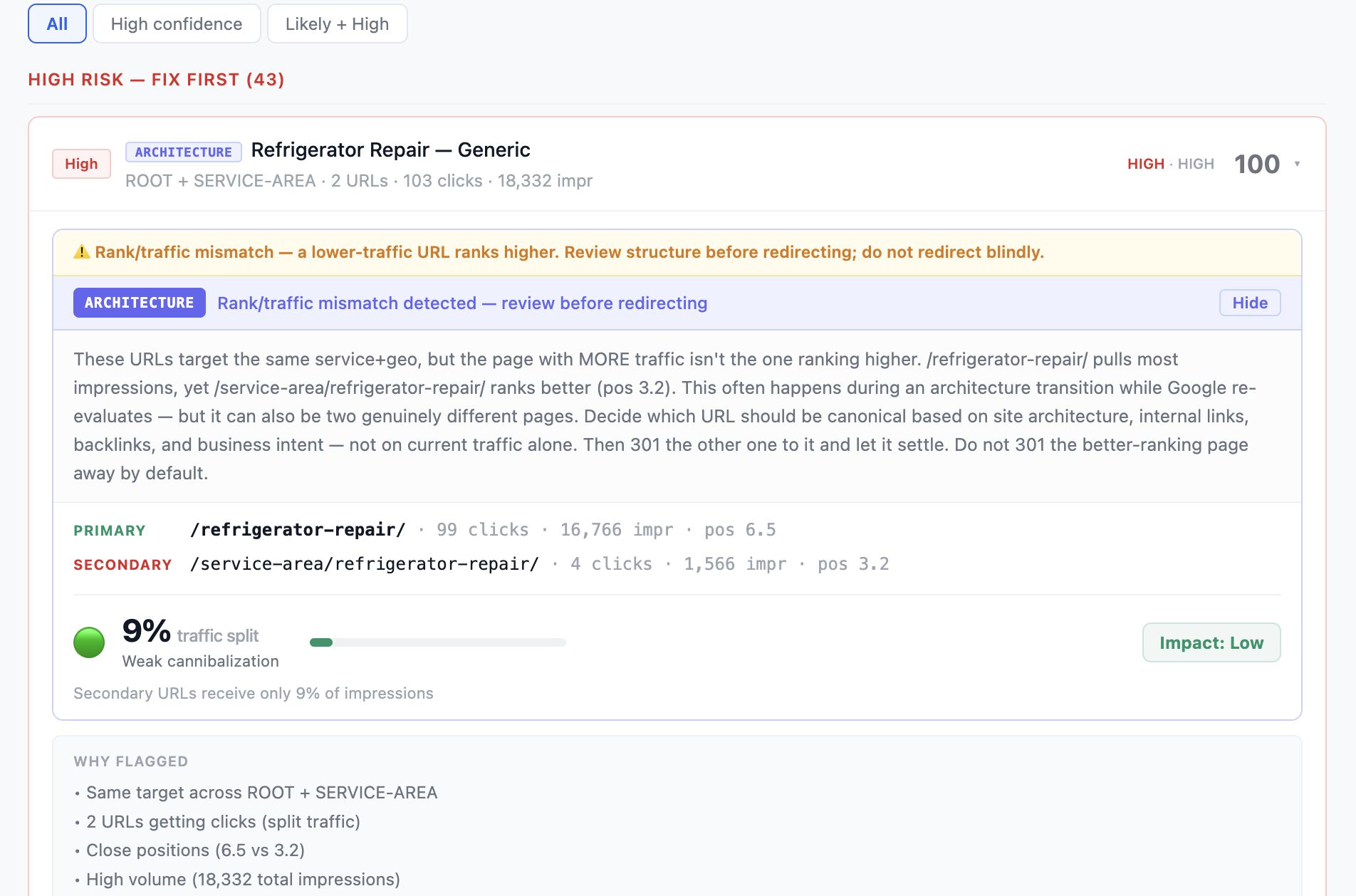
/refrigerator-repair/ — 99 clicks, 16,766 impressions, position 6.5
/service-area/refrigerator-repair/ — 4 clicks, 1,566 impressions, position 3.2
By clicks, the root page looks primary. By position, the service-area page is actually ranking better. Traffic split is only 9% — weak cannibalization overall.
A standard tool sees two URLs competing and says: redirect the service-area page to the root. You do it. You just 301'd away a page that was ranking at position 3.2. Your rankings drop. You spent weeks wondering why.
This is not a hypothetical. I've seen it happen.
The 3 Types of Conflicts — And Why They Need Different Fixes
After running this analysis across multiple sites, the conflicts I found fell into three categories that require completely different responses:
| Category | What It Means | Right Action |
|---|---|---|
| 🟢 Ready to Fix | True duplicate — same intent, same audience, one clearly primary | Consolidate with 301 redirect |
| 🟡 Manual Review | Signals mixed — rank/traffic mismatch or unclear which page serves users better | Human decision required before touching anything |
| 🔵 Architecture Conflict | Structural issue — pages exist for different reasons, not actually competing | Fix architecture, not content |
Treating all three as "redirect and move on" is the mistake. It's fast, it looks decisive, and it frequently makes things worse.
The Tool I Built
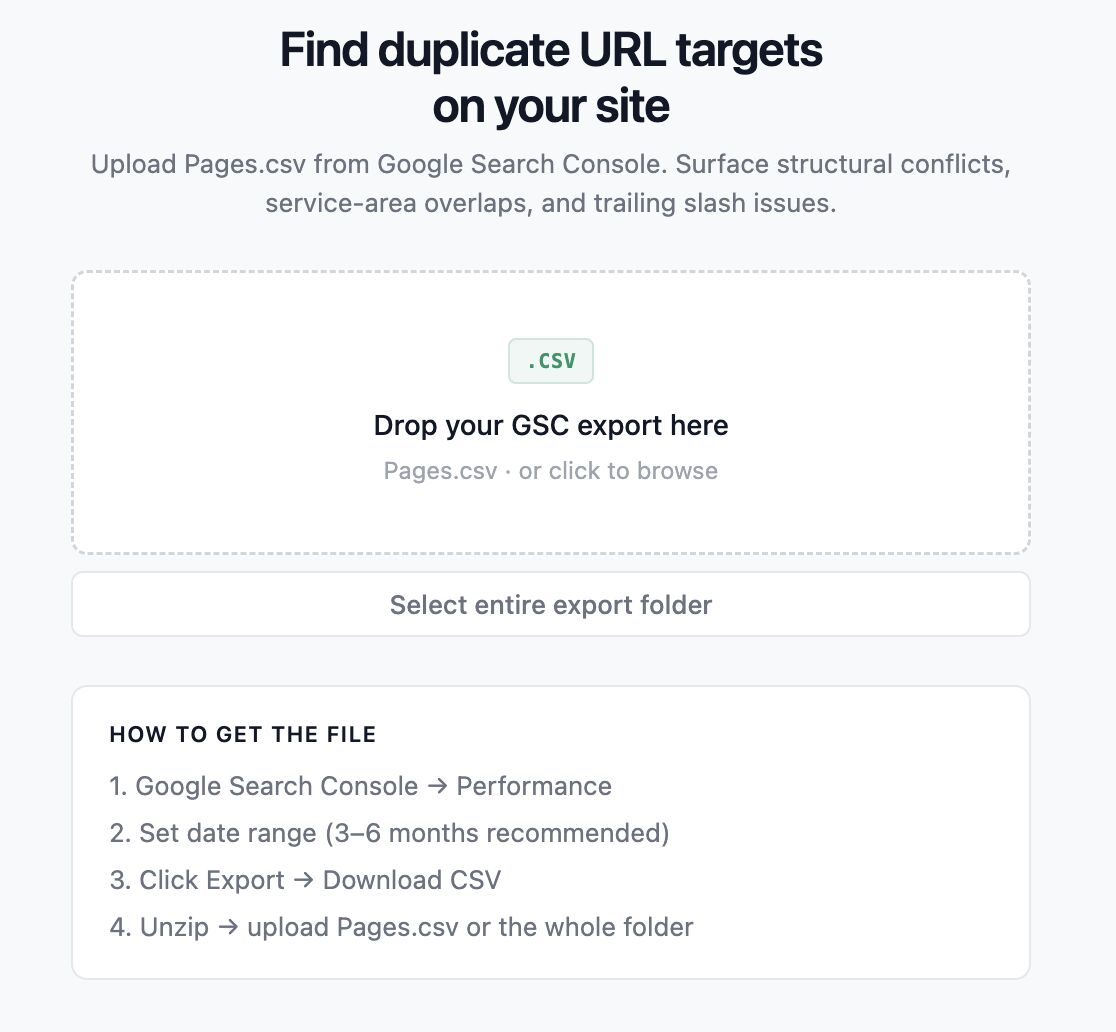
The tool takes a Pages.csv export from Google Search Console — the same data you already have, no paid tools required — and surfaces conflicts with enough context to actually make a decision.
How to get your file:
- Google Search Console → Performance
- Set date range (3–6 months recommended)
- Click Export → Download CSV
- Unzip → upload Pages.csv
What the tool does differently from standard cannibalization checkers:
| Standard Tool | This Tool |
|---|---|
| Identifies conflicts by keyword overlap | Identifies conflicts by URL pattern + ranking signal analysis |
| Recommends redirect based on clicks | Flags rank/traffic mismatches before recommending anything |
| Treats all conflicts the same | Separates true duplicates from architecture conflicts |
| No context on why pages were flagged | Explains exactly why each conflict was included |
| No impact estimate | Shows traffic split % and expected impact per conflict |
The key difference: it identifies the primary URL using rankings and traffic signals together, not clicks alone. And it explicitly flags rank/traffic mismatches — cases where the lower-traffic URL is actually ranking better — as high-risk before any redirect is recommended.
How does cannibalization hurt local service rankings?
When Google sees two pages competing for the same query, it has to decide which one to show. It splits its evaluation signals between them. Neither page builds the authority it would have as the sole target.
The specific impact on local service sites:
| What Gets Split | Effect on Rankings |
|---|---|
| Backlink equity | Each link to either page is diluted across both |
| Click signals | User engagement data split between two URLs |
| Crawl budget | Google crawls both pages instead of investing depth elsewhere |
| Internal link authority | PageRank distributes to two pages instead of concentrating in one |
| Featured snippet eligibility | Two competing pages reduce the chance either wins |
For a multi-location site with 300+ pages, unchecked cannibalization compounds over time. Pages that should be ranking on page 1 stay on page 2 because their signals are being shared with a page that shouldn't exist independently.
What Makes This Hard on Multi-Location Sites Specifically
The architecture of a well-built local service site creates natural conflict zones:
Root vs service-area pages — /refrigerator-repair/ and /service-area/refrigerator-repair/ target similar intent but serve different structural purposes. The root page is the canonical service page. The service-area page is the geographic distribution layer. These need to coexist, not compete. This is the single most common conflict on multi-location sites, and it's what a service area cannibalization audit untangles URL by URL before anything gets redirected.
City pages vs ZIP code pages — /atlanta/appliance-repair/ and /30301/appliance-repair/ target overlapping geography at different specificity levels. The ZIP page should funnel to the city page, not compete with it.
Service pages vs informational blog posts — /dryer-repair/ and /blog/dryer-not-heating-fix/ can cannibalize each other if the blog post tries to rank for service-intent queries instead of informational ones.
Each of these requires a different fix:
| Conflict Type | Wrong Fix | Right Fix |
|---|---|---|
| Root vs service-area | Redirect service-area to root | Canonical tag + internal linking hierarchy |
| City vs ZIP code | Redirect ZIP to city | ZIP page signals to city hub via internal links |
| Service vs blog | Redirect blog to service | Rewrite blog for informational intent, not commercial |
| True duplicate pages | Nothing | 301 redirect weaker to stronger |
What AI Systems Look For in This Content
For AI Overviews and AI citation purposes, cannibalization matters beyond just rankings. When Google's AI systems scan your site to understand what you're an authority on, conflicting signals from competing pages create ambiguity.
A site with clean URL architecture — one clear page per topic, proper canonical structure, logical internal linking — is easier for AI to interpret as an authority source. A site with 5 pages all trying to rank for "refrigerator repair Atlanta" sends mixed signals about which page represents the business's authoritative answer.
This is increasingly relevant as AI systems like Google AI Overview, ChatGPT Search, and Perplexity decide which sources to cite. They favor sites with clear, structured, non-conflicting content signals. Cannibalization cleanup is now part of AI visibility optimization, not just traditional ranking work.
Who is this keyword-cannibalization tool for?
Built specifically for multi-location service businesses and the SEOs who work with them:
- Appliance repair, HVAC, plumbing, roofing, cleaning services, electrical
- Any business with root pages + service-area pages + city pages + ZIP pages
- Sites that have grown their content structure organically and now need to audit for structural debt
- SEOs doing technical audits who need a faster way to triage conflicts before deciding on fixes
Still early — I'm actively developing it and looking for local SEOs and agency owners willing to stress-test it on real sites.
If you want access to run it on your site, or if you're dealing with cannibalization issues you're not sure how to approach — let's talk. I can run the audit and walk through what the data shows.
Related:
- From 64 to 1,174 Pages: How I Built a Local SEO System That Drives 4-5 Organic Leads Per Day
- 35,500 to 148,000 Impressions: Why Templated SEO Gets You Nowhere
- Before You Copy Someone's SEO Results, Understand Their Business Model
- Google AI Overviews: What Home Service Businesses Need to Know in 2026
- Testing My SEO Framework in a Completely Different Niche