Is a $70,000 AI Visibility Contract Different From a $10,000 One, or Are You Buying Seats?
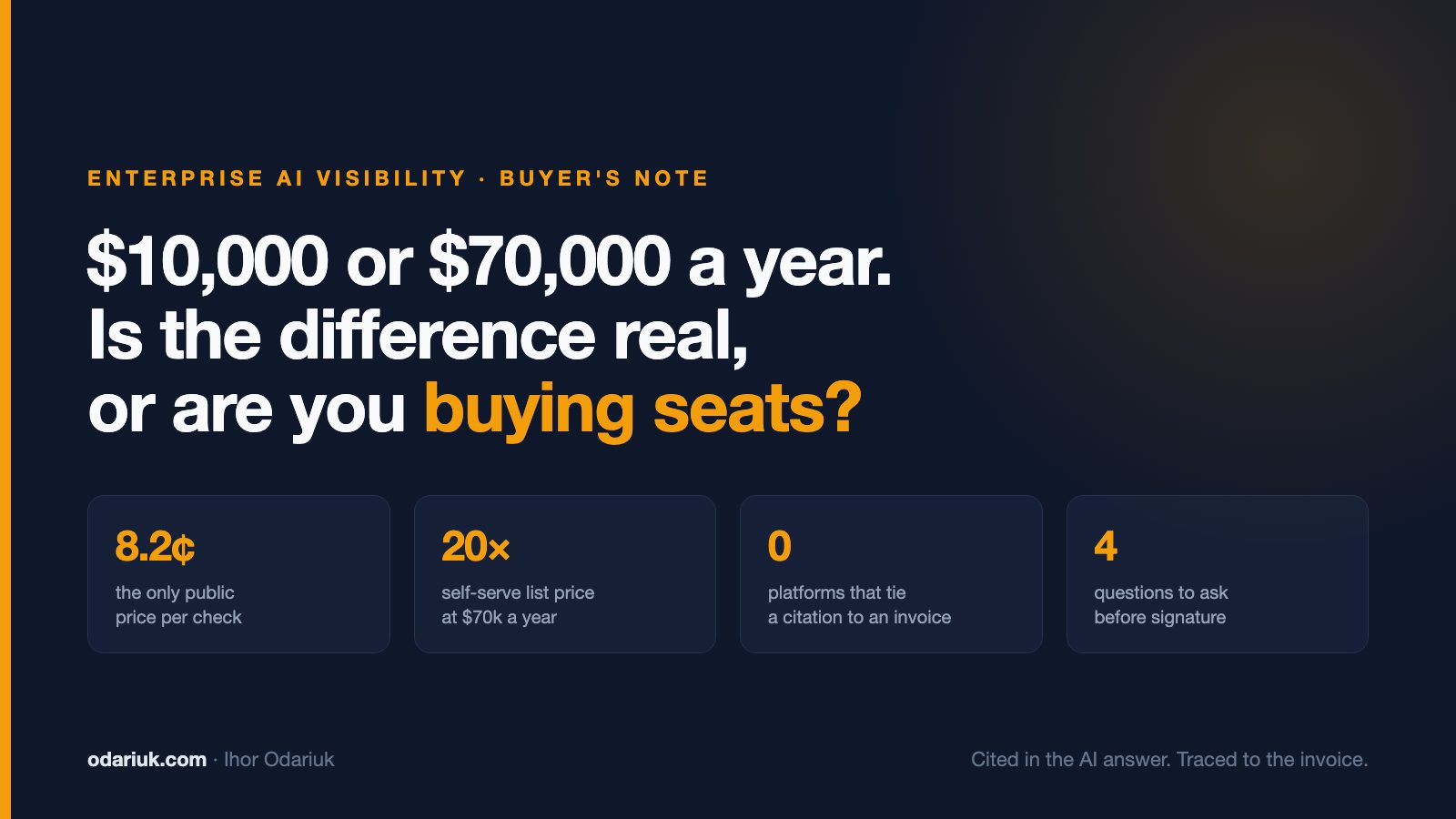
I have written about what this category costs at the bottom — the $29 tools, the $5,000 audits, the $2,500 retainers. This piece starts where that one ends: at the quotes that arrive as a PDF, with no price on the vendor's website, addressed to somebody who has to defend the number to a board.
The question I keep being asked, in three different phrasings, is the same question: is the difference between the $10,000-a-year tier and the $70,000-a-year tier real, or is it seat count with a story attached?
It is real. It is also almost never the difference the buyer thinks they are paying for. And in most mid-five-figure quotes I have been shown, the single most expensive line item is a measurement the vendor structurally cannot take.
What are you actually buying when the quote goes from $10,000 to $70,000 a year?
You are buying resolution and access, not outcome. Every platform in this category does one mechanical thing: it sends a list of prompts to a list of AI engines on a schedule, reads the answers, and records whether you were named or cited. The price scales with how many times that loop runs and who inside your organisation is allowed to look at the result. It does not scale with whether the answers change.
Three things genuinely move as you go up the ladder, and they are worth different amounts to different companies:
- Check volume. The industry unit is one prompt × one engine × one location. Your tier decides how many of those you get a month, which decides whether your dashboard is a measurement or a monthly coin flip.
- Engine coverage. Which assistants are in the number at all. Engines that are excluded are not reported as "unmeasured" — they are reported as zero, which reads on a dashboard exactly like absence.
- Organisational machinery. SSO, audit logs, role-based access, multi-region and multi-language, persona targeting, an executive dashboard your BI tool can read, white-glove setup, a named contact.
That third bucket is where most of the money between $10,000 and $70,000 goes, and it is legitimate spend — for a regulated company or a public-affairs shop, an audit log is not a nice-to-have. But notice what it is: procurement and governance features, priced as if they were measurement quality. Ask a vendor to separate those two things in the quote and you learn a great deal about the vendor.
What do the published numbers actually say?
Almost nobody in the enterprise band publishes anything, which is itself the finding. Of the platforms most often put side by side in these procurement conversations, exactly one publishes a real self-serve price with the limits attached, and it is the anchor everything else should be measured against.
As published at the time of writing, September 2026 — verify all of it before you sign, because this market repriced twice while I was writing about it:
| Vendor | What is published | What is not |
|---|---|---|
| AthenaHQ | Free Essential tier ($25 of credit, 300 credits). Starter $295/month, 17% off annual, 3,600 credits/month, visibility across 10 models including ChatGPT, Perplexity, AI Overviews, AI Mode, Gemini, Claude, Copilot, Grok, DeepSeek and Meta AI. API access and extra credits are paid add-ons. | Enterprise is "custom" — adds SSO (SAML/OIDC), audit logs, multi-region and multi-language, persona targeting, executive dashboard with BI support, white-glove setup. No number. |
| Suede Web Systems | Nothing. The site routes to "Book a Demo". Describes itself as AI visibility and narrative intelligence, claims millions of persona-specific prompts across ChatGPT, Gemini, Copilot, Claude, Grok and Perplexity, and sells into Public Affairs & Policy, Campaigns & Advocacy, Corporations and Regulated Industries. | Price, check volume, contract floor — all of it. |
| Profound | $99/month Starter and $399/month Growth, both billed annually. | Enterprise on custom terms. |
| Peec AI | Four tiers on the page — Starter, Pro, Advanced, Enterprise. When I checked on 7 September the numbers were gone; earlier the same month the published ladder was roughly $95 / $245 / $495. | Prices now sit behind sign-up or sales. |
One line in that table does more work than the rest. AthenaHQ publishes $295 a month for 3,600 credits. That is 8.2 cents per check at list price, from a vendor with an enterprise tier, in writing, on a public page. It is the only hard reference point this category has given you.
So run your quote through it.
- $10,000 a year is $833 a month — about 2.8× that published self-serve price.
- $70,000 a year is $5,833 a month — about 20× it, and at list rate roughly 71,000 checks a month.
Now ask your vendor how many checks their enterprise tier actually runs for you. If the honest answer is materially below the number your spend implies at published rates, that is not a scandal — it means you are buying governance, personas, and people. That may be exactly right for you. But you should be able to say out loud which one you are buying, and right now most buyers in this category cannot.
Should you bid Suede against AthenaHQ on price?
No — and this is the mistake I most want to talk somebody out of, because on a procurement spreadsheet it looks obviously correct and it is not. These two vendors do not sell the same product, and running a price bid between them means the cheaper one wins a job it was not built to do.
Read their own positioning rather than the category label both of them wear:
AthenaHQ is a marketing-side AI search visibility platform. Self-serve tier, published price, credits, competitor tracking, content recommendations, an optimisation agent. The buyer is a growth or SEO team, and the output is meant to change what your content does.
Suede describes itself as AI visibility and narrative intelligence, built around persona-specific prompts, aimed at Public Affairs & Policy, Campaigns & Advocacy, Corporations and Regulated Industries. The buyer is communications, government relations or legal, and the output is meant to tell you how assistants are characterising your organisation, your issues, your opponents and your people.
One of those answers "are we recommended when a customer asks for our category?" The other answers "what does ChatGPT say about our position on this bill, and did it shift this week?" A public-affairs organisation that buys the marketing tool because it quoted 40% lower has not saved money — it has bought a product with no answer to the question it needs answered. Equally, a services company that buys narrative intelligence to fix its category visibility is paying for surveillance it will never action.
The right sequence is the opposite of a price bid. Name the internal owner of the output first — comms or growth. Write down the one decision the dashboard is supposed to change. Then take quotes only from vendors whose product serves that decision, and then negotiate price among products that are genuinely comparable. If two quotes for "AI visibility" differ by 5× and you cannot articulate which decision each one serves, the spread is not a negotiation opportunity. It is a sign you are comparing two different purchases.
Why does a vendor refuse to publish any price at all?
Because when scope is set per deal, the price can be anchored to your budget rather than to the work. That is not necessarily dishonest — genuinely bespoke enterprise work is hard to list on a page — but it has one consequence you should price in: you are negotiating with no reference point, against a seller who has seen a thousand of these and knows what your sector pays.
There is a second, quieter reason. A published price is a public commitment to a defined scope. Vendors avoid it when scope is the thing that moves. In a category where the underlying mechanic is "send prompts, read answers", the honest way to publish is to publish the check allowance — which is precisely why the one vendor that publishes credits gives you so much more leverage than the ones that publish adjectives.
Three procedural moves, and they cost nothing:
- Ask for the floor in writing. Not the quote — the smallest engagement they will sign. A vendor who cannot name it is telling you the price is a function of you, not of the work.
- Ask for the check allowance as a number, per month, and the exact engine list included at your tier.
- Ask what the same package cost six months ago. Repricing in this category has been violent in both directions, and the answer tells you whether you are early enough to be a reference customer or late enough to be margin.
Is a mid-five-figure quote in line with the market?
There is no market rate, because there is no standard unit — and any vendor or advisor who tells you "$40,000 a year is normal for a company your size" is quoting a feeling. What exists instead is a defensible way to test whether your quote is in line, and it takes about twenty minutes.
Take the annual number, divide by twelve, and split the monthly figure into three buckets the vendor must agree to in writing:
Measurement. Checks per month × engines × locations, at a rate you can compare against the 8.2 cents per check that is publicly on the table. This bucket is commoditising fast and should be shrinking as a share of your spend, not growing.
Governance. SSO, audit logs, retention, multi-region, access control, security review. Price this honestly against what your compliance function would otherwise build. For a regulated organisation it can be most of the value. For a fifty-person services company it is usually zero, and it is frequently the reason the quote has a seven in front of it.
People. Onboarding, a named contact, prompt-set design, quarterly review, anything a human does. This is the bucket where quotes diverge most and where you are most likely to be paying platform margin for work you could buy directly at half the rate.
If a vendor will not split the quote three ways, that refusal is the answer. The split is not commercially sensitive. It is only awkward when one bucket is much smaller than the price implies.
What does no platform in this category include, at any price?
Three things, and they are the three that decide whether the spend was worth it. This is not a knock on the vendors — it is structural. They are outside your business, sampling from outside, and there are things you cannot see from out there.
One: what your own server actually saw. Every platform in this category infers AI activity by asking engines questions. None of them can see the assistants that came to your site and fetched pages while answering a real person. On one client's log I recorded Claude fetching pages 129 times in eight days, second only to ChatGPT — while a tool tier that excluded Claude would have reported that engine as zero. Not "unmeasured". Zero, on a dashboard, in a board pack. I published an open dataset of what those crawlers actually do so this stops being a claim and starts being evidence.
Two: whether the movement is you or the instrument. These numbers are samples, and the denominator is the prompt list. Change the list and the score changes. I have watched a frozen metric in a vendor panel fall from 194 to 25 while receiving no new data at all, because the vendor was recomputing its index behind the scenes. Small month-over-month moves in these tools are usually the instrument. If nobody in the room can tell you which, the reporting is decorative. How to read these dashboards without being fooled by them is a longer argument, written from the position of someone who pays for one.
Three: whether any of it produced revenue. No platform in this category can connect "we were cited in an answer" to "a customer arrived, booked, and was invoiced." Assistants strip referrers, so those visits land in Direct in your analytics and the trail stops. Being present in the answer and being chosen are different events, and I have measured a client whose citations went from 1 to 813 in six weeks across seven engines — a real, verified move — while the question "did that produce work?" required an entirely separate instrument to answer. That gap is the whole subject of full-cycle attribution, and it is the reason I would rather spend a client's fourth ten thousand dollars there than on a higher tier of the same sampling.
A $70,000 contract that cannot answer question three is a $70,000 contract that will be cancelled in year two, by a CFO who never got an answer to the only question that was ever being asked.
What are the four questions to put to any vendor before you sign?
These are the ones that change the conversation. I have watched all four land, and I would want a client to ask me the same ones.
- "What would failure look like in your reporting?" If nobody at the vendor can describe how their instrument would show the work not working, you are not buying a measurement. You are buying a number that only goes up.
- "Which engines are in this tier, and which are excluded — in writing?" Excluded engines get rendered as absence. This is the single most common way an expensive dashboard tells a comfortable lie.
- "How many checks a month, and what happens when we exhaust them?" Then compare against published rates. This is the only line item in the quote that can be benchmarked at all, so benchmark it.
- "Show me the same brand's visibility computed two different ways." Two prompt sets, or your number next to another vendor's. If the two answers disagree wildly — and they will — you have just discovered how much confidence the metric deserves before it reaches your board.
None of those four require you to know anything about generative engine optimisation. They require the vendor to be specific, which in this category is a filter that removes most of the room.
Who is telling you this, and what have they actually shipped?
Fair question, and one I would ask. I sit on both sides of this trade: I pay for one of these platforms and use its data in client work, and I built the server-side instrument none of them provide — because I needed an answer they structurally could not give me.
The measured record, from Search Console rather than a case-study deck. On a multi-location US client over sixteen months: 961,997 impressions, 9,728 clicks, average position 10.4 (pulled from the API on 22 September 2026). Comparing the last six months against the six before them, impressions went 98,712 → 838,495 and average position 17.1 → 9.4. Indexed pages went 64 → 1,174; referring domains 29 → 212. On the AI side, citations went 1 → 813 in six weeks, tracked across seven engines. The long version of each is written up as a local SEO case study and an AI citation case study, including the parts where presence did not convert into orders — because that is the interesting half.
I also publish my prices. In a category where the enterprise band publishes nothing, that is the differentiator, and it includes the engagements I think most companies should not buy from me.
What should you do before you sign the quote in front of you?
Send it to me. A second opinion on a quote costs nothing, takes me under an hour, and comes back as three things: which of the three buckets your money is actually in, which line items are benchmarkable against published rates, and the two or three questions I would put to that specific vendor before signature.
If you would rather know what is true about your own AI visibility before anyone quotes you anything, the four-layer audit is the diagnostic — what the assistants can actually fetch from you, per agent; what they are already pulling; whether you own anything an engine would want to quote; and whether your attribution chain could tell you if AI sent you a customer. It is the same instrument I run before I take on a retainer, and it is deliberately built to be able to come back with "you do not need me."
And if the answer turns out to be that you need the measurement wired into your own systems rather than rented from a dashboard, that is what I build — the tracker on your infrastructure, the attribution chain from citation to invoice, and the work that changes what the answers say. Terms and engagements are written out, no discovery-call gate.
The worst outcome in this category is not overpaying. It is paying enterprise money for eighteen months and still not being able to answer, in a board meeting, whether any of it brought in a customer. Let's talk before that becomes your year.
I publish prices, methods of measurement, and the datasets behind my claims because in this market that is the differentiator. Engagements are on pricing; the measurement instrument is described on the Citation Tracker page. If you are holding a quote and want it read by someone with no commission attached to it, send it over.
Related: